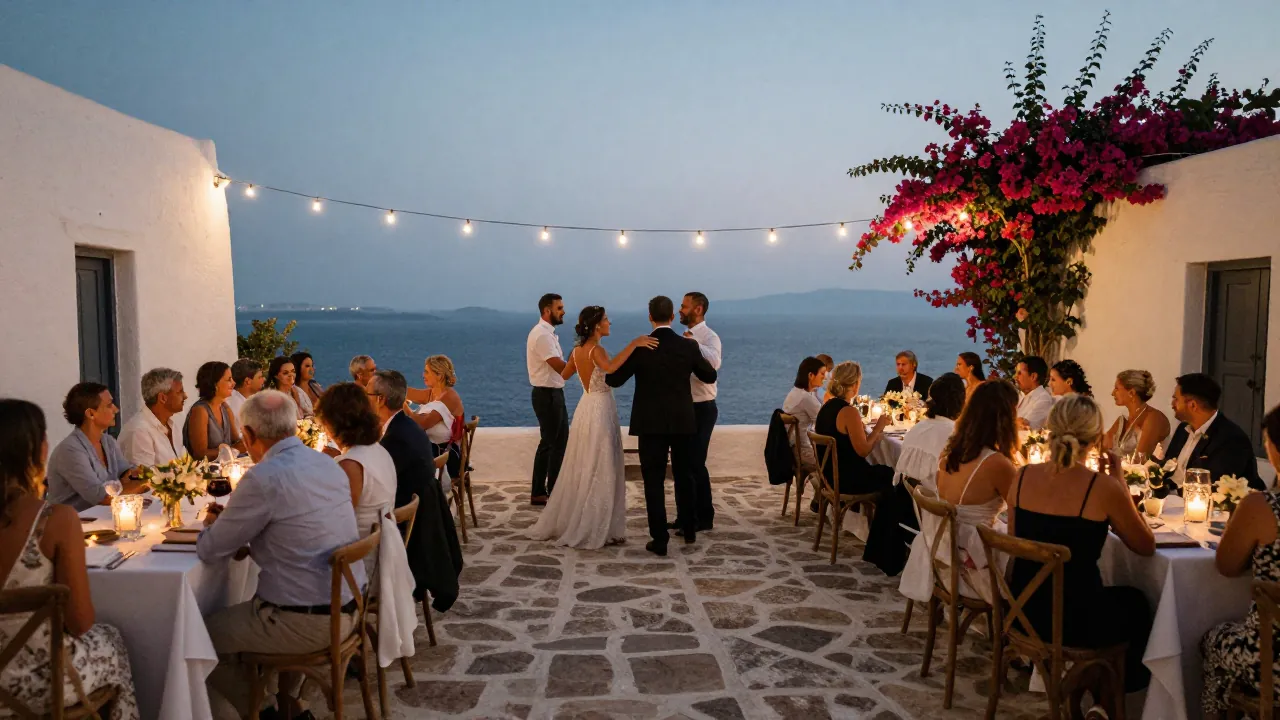
What a circle dance actually asks of a room
Kalamatianos and syrtos are line and circle dances: guests link hands, the leader sets the direction, and the line grows as people join. That shape has consequences a rectangular dance floor plan doesn't capture.
- The line needs to close into a loop or extend without hitting a wall, column or table edge.
- The leader needs space to step forward and turn the line.
- Guests who aren't dancing should still be able to walk past without crossing the ring.
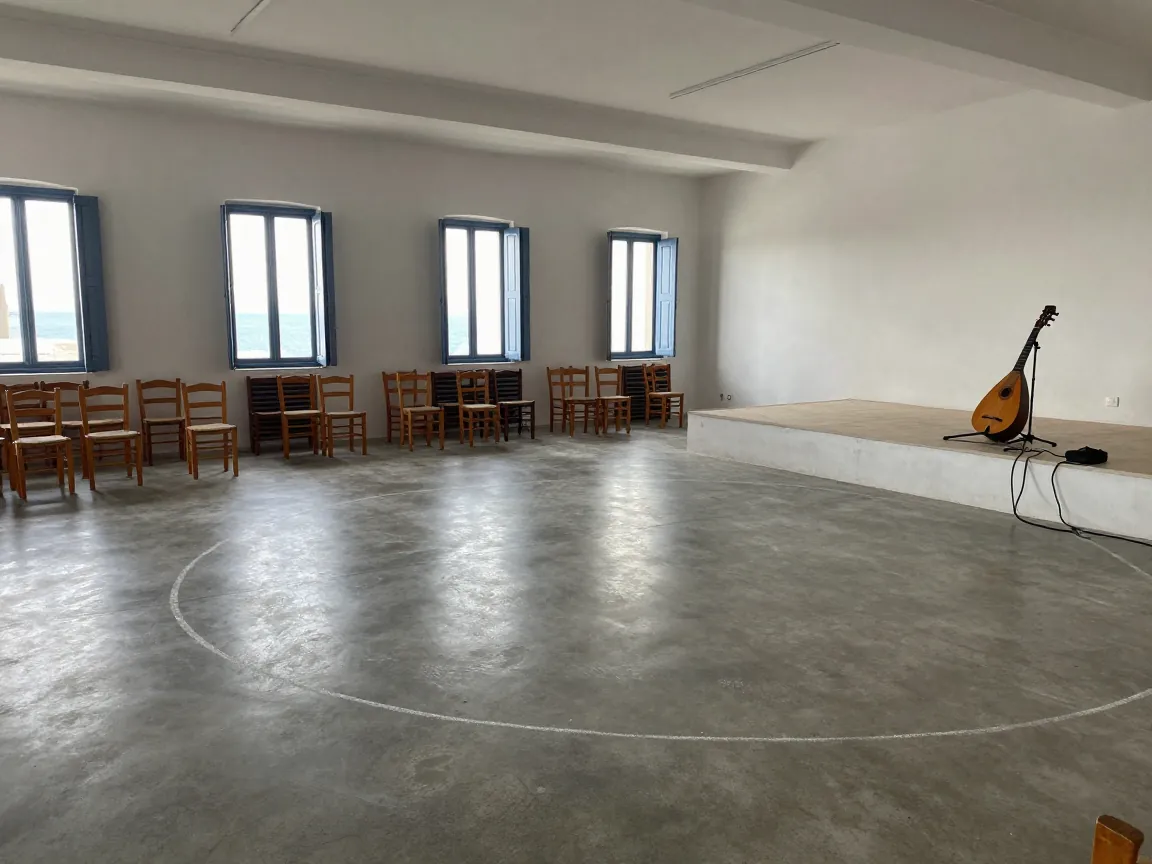
A useful test when you view a space: stand at the centre, stretch both arms out, and imagine two linked lines of guests passing in front of you. If the line would brush a waiter station or a speaker stack, the ring is too close to something.
The Hellenic Ministry of Foreign Affairs notes that Greece has thousands of traditional dances from its regions, alongside Pan-Hellenic dances danced across the Greek world. Your guests may know different versions from different places, so the band should expect requests rather than assume one fixed repertoire.
Circle space, floor surface and where the band stands
Sizing a dance area is not a formula, but the ring shape changes the arithmetic. A loose working guide, all numbers hypothetical examples rather than venue facts:
| Guest count (example) | Circle diameter to aim for | Notes |
|---|---|---|
| 40 guests | 3 to 3.5 m clear | One line, one direction |
| 80 guests | 4 to 5 m clear | One circle plus room for joiners |
| 120 guests | 5.5 to 6.5 m clear | Two circles or one large ring, separate from dining tables |
Ask what the floor is made of. Polished marble can get slippery; tile is usually fine; a low-pile carpet can slow turns and tire dancers over a long set. If the room has a rug over stone, ask whether it can be lifted for the dancing hours. Flat shoes help more than any surface change, so mention this to guests in the invitation if the room is marble.
Band placement matters as much as size. A band facing the ring from one side keeps eye contact with the leader, while a band tucked behind the head table tends to play to the wrong side of the room. Ask whether the venue has a power point near the dance area and whether the band brings its own small PA or plugs into a house system. DJs need a table and a clear sightline to the floor; if they're hidden in a corner, they can't read when the tempo is dropping.
When the church runs late and the dancing starts later
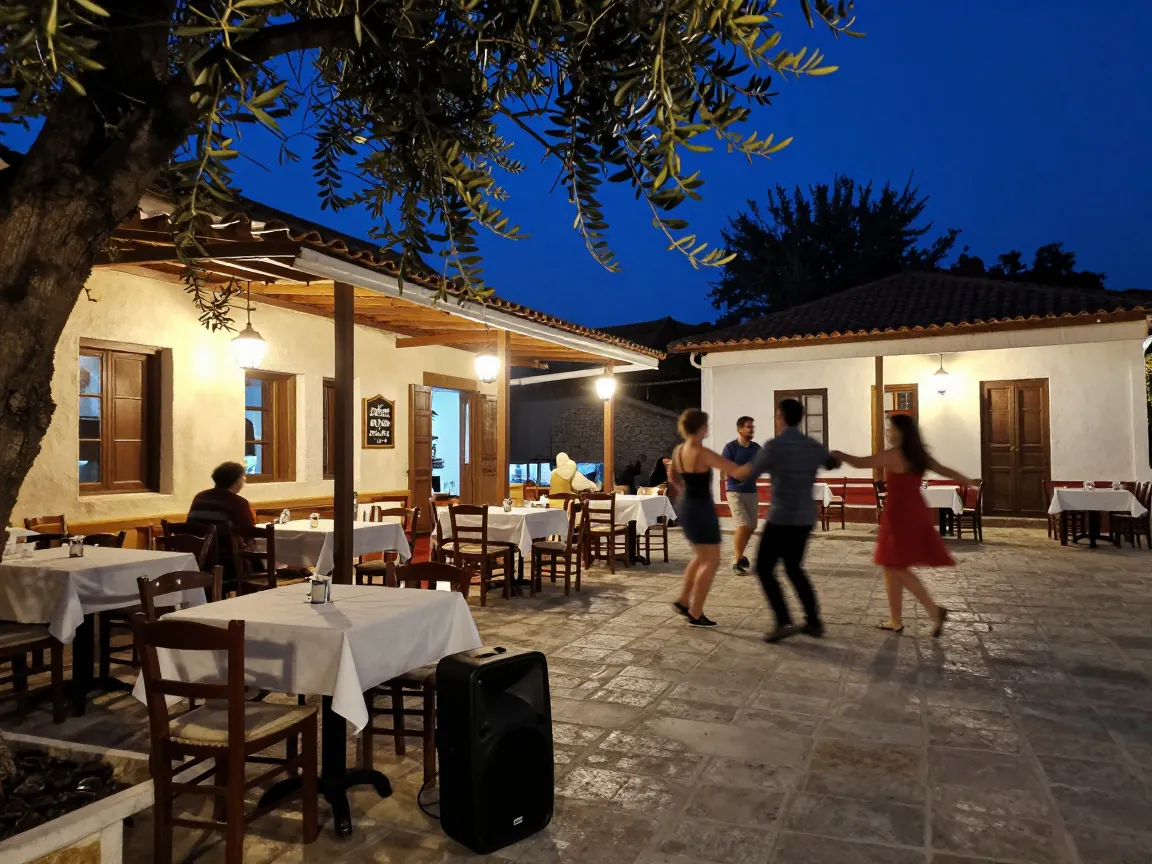
Greek receptions often begin after a church service, and in many the dancing starts after dinner rather than during cocktails. That compresses the dancing window. Our view: build the running order backwards from the venue's music end time, not forwards from the first dance.
Work through this order with the bandleader or DJ before the day:
- Entrance and first dance (if you're having one).
- Dinner service, with low-volume background music.
- First circle set: kalamatianos, syrtos and whatever regional circle dances the families ask for, in the keys the band prefers for singing.
- A slower set of regional songs while guests rest and drink.
- Second circle set, when guests who arrived late have joined.
- Requests and free dancing until the cut-off.
Give the band a written start and stop time for each block. Two copies, one for the band, one pinned near the door for the venue manager. If the couple's families come from different regions, ask relatives in advance which two or three songs must be played, and pass those titles to the band in writing.
For more on how the evening sequence fits together, see our Greek wedding timeline from church to last dance.
Briefing a band or DJ in writing
A one-page brief settles most arguments before they happen. Include:
- Guest count, marked as an estimate, plus how many guests are likely to dance.
- The circle-space size you've agreed with the venue.
- Floor surface and any restrictions on shoes.
- The running order above, with times.
- Names of the songs or dances that must be played, and by whom they were requested.
- The venue's music end time, and who is responsible for stopping.
- Whether there's a sound limit after a certain hour, or a neighbour agreement.
- Contact numbers for the couple's designated family member and for the venue manager.
If the band is amplified and the reception is outdoors, the end time is the single most important number on the page. Our guide to music end times outdoors covers the questions to ask. Noise rules vary by municipality and by site, so confirm the current requirements with the venue and the competent municipal authority rather than relying on a general rule.
Questions to put to the venue about floor and end time
Put these in writing before you sign anything, and get answers from the venue, not from a friend who held a party there three summers ago.
- Is the dance area part of the booked room, or can it be closed off at a certain hour?
- What is the floor surface in the dancing area, and can anything be laid over it?
- What time must amplified music stop, and does that change for live acoustic sets?
- Is there a stage, riser or power point near the dance area?
- Can the room be rearranged between dinner and dancing, and who moves the tables?
- Are there other events in the same building that night, and do they share walls with your room?
- Who has the authority to cut the music if a limit is reached?
Once the venue answers, compare it with other wedding reception venues in Greece that handle dancing as part of the package rather than an add-on. The listing says what each venue offers; it doesn't guarantee availability, so ask directly.
Two caveats from us. First, a big ring isn't always better: if your guest list is small, a six-metre circle can look empty and keep people from joining. Second, if your family doesn't dance, don't build the evening around it. A band playing to a full dining room is a waste of money. Ask your relatives honestly who will get up, then size the floor accordingly.
Send us your guest count, your date and the region you're considering, and we'll point you towards venues whose rooms can hold a proper circle and whose licence allows the music to run late enough.
Planning questions
How big should the dance floor be for a Greek wedding?
Base it on the circle, not the guest count alone. For around eighty guests, aim for a clear ring about four to five metres across, with nothing inside it. For a group of around forty, our example figure is roughly three metres. Always stand in the space and imagine a linked line moving through it.
What should we write in a brief for the band or DJ?
One page: guest estimate, circle size, floor surface, the running order with times, the songs that must be played, the venue's music end time, and who stops the music. Give a copy to the band and one to the venue manager.
Which venue questions matter most for dancing?
Ask about the floor surface, whether the dance area can be rearranged after dinner, the exact time amplified music must stop, power near the floor, and who enforces any sound limit. Get written answers before signing, and confirm current rules with the municipality.