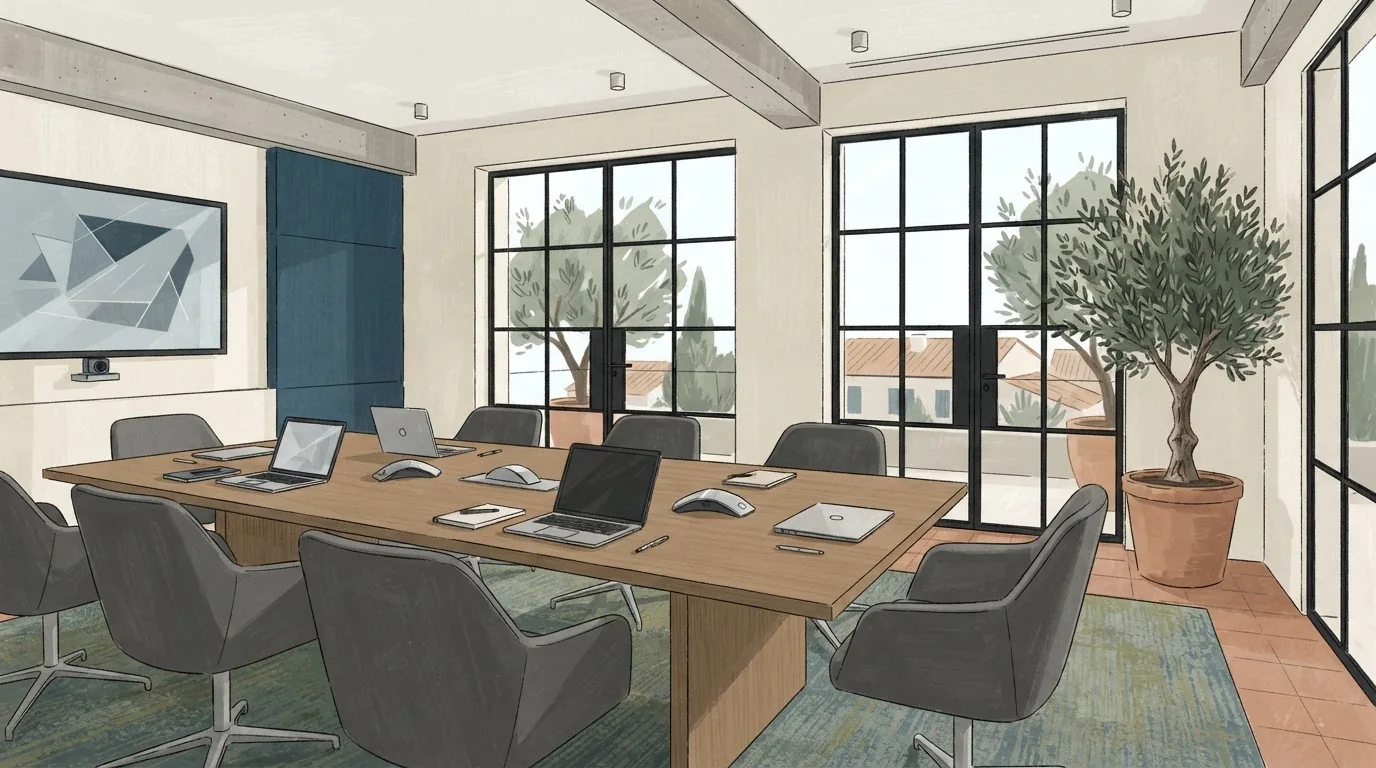
The room is a space with a door and a table. The day is everything that makes the meeting work. If you only ask for the room, you'll get a quote for the room. That's not a trick, just how hire contracts work.
The day rate is not the day
A day rate is often a hire fee for the room during standard hours. It might include basic furniture and Wi-Fi. It might not include an early access slot for setup, a technician to check the screen, lunch, or the half hour after the official end when people are still talking. Those items can be quoted separately, bundled, or left out entirely. The only way to know is to ask for a written quote that lists them.
This matters because meeting budgets rarely fail on the room fee. They fail on the extras that arrive later. A projector cable, a flipchart, a coffee urn, a later finish. None of those are dramatic on their own. Together they change the total. Ask for the full list before you compare anything.
Eighteen people changes the room, not just the count
Example: 18 attendees in a boardroom layout need a table that seats everyone without a second row. In a theatre layout, 18 is small. In a U-shape, it's comfortable. In a cabaret layout, it's a different room. The layout determines whether the quoted room works at all. Ask the venue to confirm the layout in writing, not just the capacity.
Eighteen also affects catering. A coffee break for 18 is not the same operation as a coffee break for 8. It needs a service point, a queue that doesn't block the meeting, and a clear time slot. If the quote says "catering available," ask what that means for 18 people at 10:30 and 15:00. Blank fields are better than guessed numbers.
Build the quote request as a template
The useful artifact here is a quote request you can paste into an email. It asks for the full day, not just the room. Keep it as a table so you can compare replies side by side.
| Item to request | What to write |
|---|---|
| Room and date | Date, start time, end time, 18 attendees |
| Access for setup | Ask for access 60 minutes before start, and confirm if that is charged |
| Layout | Boardroom, U-shape, theatre or cabaret. Ask which fits 18 |
| AV | Screen, projector, HDMI, sound, technician on call. Ask what is included and what is extra |
| Power and internet | Sockets at the table, guest Wi-Fi, wired backup |
| Catering | Coffee on arrival, mid-morning break, lunch, afternoon break. Ask for per-person and minimum charges |
| Service | Service charge, VAT, or tax as quoted. Ask which amount it applies to |
| Overrun | Cost per 30 minutes after the booked end |
| Cancellation | Deadline and any fee |
| Invoice | Total, deposit, payment date, cancellation terms |
Send this to several venues. The replies will not match, and that's the point. One may include AV and exclude catering. Another may include catering but charge for setup. A third may quote a lower room rate and a higher service charge. You can't compare them until the same lines are filled in.
Ask about arrival, not just the address
If your attendees are flying in, the meeting starts at the airport. Metro Line 3 connects Athens airport with central Athens and Piraeus, but you should check timetables for the actual date (Athens International Airport: public transportation). That's a planning fact, not a promise about traffic or delays. Build a buffer into the agenda rather than hoping everyone arrives at once.
For a group of 18, one late arrival can delay the first item. Ask the venue if there is a separate room or corner where early arrivals can wait without interrupting setup. Ask if the reception can hold luggage. These are small questions that protect the schedule.
Compare total cost, not headline rate
Once the quotes are in, put them into a single calculation:
Room hire + setup access + AV + catering + service + tax as quoted + overrun buffer = total day cost
If the room rate is low but the AV and catering are separate, the total may be higher than a venue with a bundled rate. If the room rate is high but includes setup and AV, the total may be lower. The arithmetic decides. There is no rule that one pricing style is better for a given group size.
A useful check is the cost per attendee for the full day. Divide the total by 18. That number is easier to compare with other venues than the room rate alone. It also makes it obvious when a small extra line changes the picture.
What to send to venues before you decide
Before you ask for availability, write a one-page brief. Include the date, the start and end time, 18 attendees, the layout you prefer, whether you need AV, whether you need catering, and your budget range if you have one. Say that you are comparing written quotes and that you need all extras listed separately. Ask for a quote and availability together, since a room is only useful if it is free on your date. Never treat a day rate as the final number without the extras.
When you contact venues, send the template table above, your one-page brief, and one clear question: "Please quote the full day for 18 people, with every extra listed separately, and confirm availability for our date." That sentence turns a day rate into a full brief, and it gives you something you can actually compare.
Finally, keep the replies in one folder. When a venue confirms the date, the layout, the AV, the catering and the overrun rate in writing, you have a brief you can approve. Until then, you have a starting price.
For each of the business-centre meeting rooms you compare, ask for the same start and finish times. Include supplier access before attendees arrive and the time needed to clear the room afterward. Put those times beside the quoted rate. A room booked only for the presentation itself leaves setup and packing unanswered, even if the headline price is clear.
Two useful next steps: A 12-person Athens board meeting needs a table test and The hybrid meeting test to run before signing.
Planning questions
How can a meeting group ensure the quoted room layout actually fits the meeting format?
Ask the venue to confirm the layout in writing, not just the capacity. For your guest count, a boardroom, U-shape, theatre or cabaret each changes whether the quoted room works, so match the layout to your agenda.
What is the right way to compare meeting room quotes when extras vary?
Use the quote request table to fill the same lines, then calculate total day cost: room hire, setup, AV, catering, service, tax and overrun buffer. Divide by your attendee count for cost per attendee.