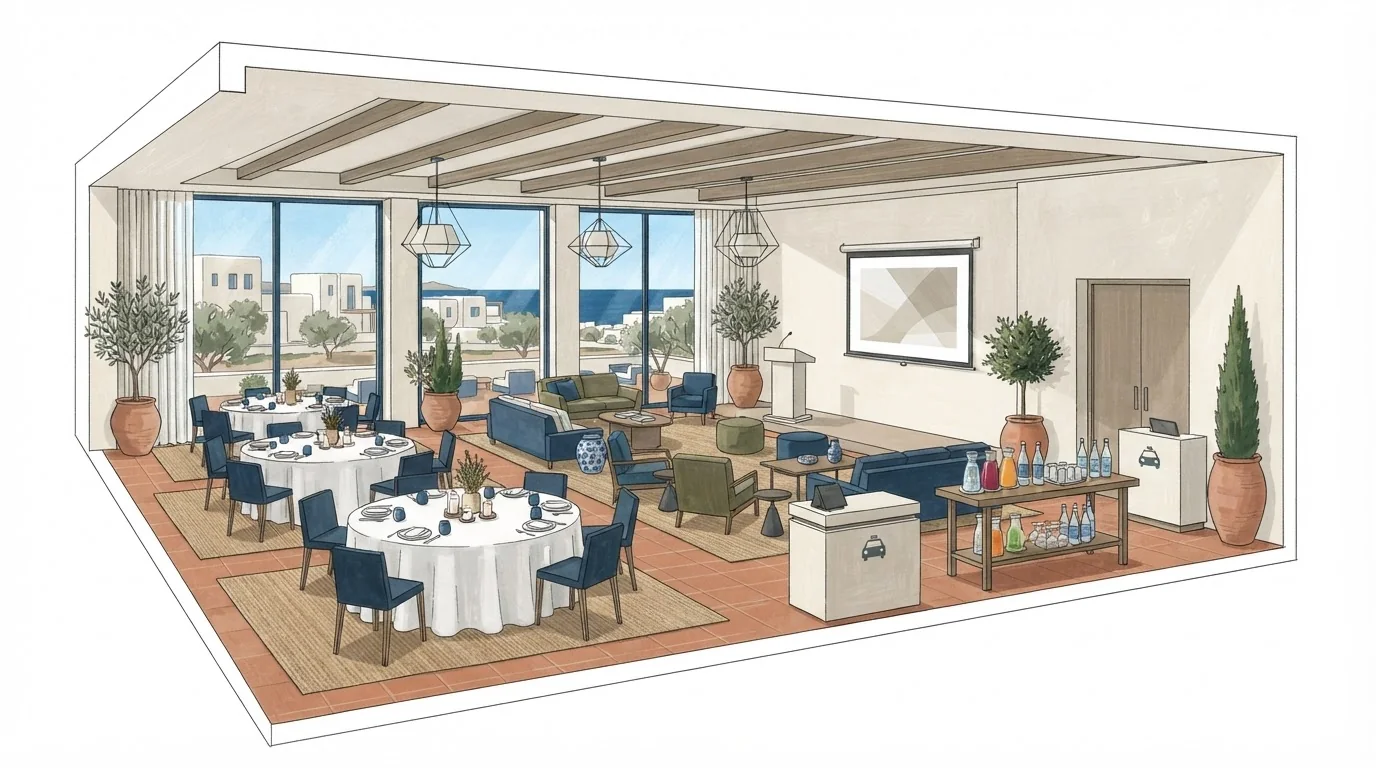
Start with the purpose, not the menu
Ask three questions, in this order. Do colleagues need long conversations across the table? Do you need a stage moment, awards or a speech? Do people want to dance? A seated dinner gives conversation and speeches a stable home. A standing reception gives movement and dancing more room. You cannot optimise all three in the same floor plan without compromise.
Write the answers down and share them with whoever signs the budget. Format arguments are usually purpose arguments in disguise. If the purpose is unclear, no menu will fix it.
What a seated dinner asks of the room
A seated dinner needs assigned seats, a service rhythm and a clear head table or stage position. It also needs enough space between tables for staff to move and for guests to leave without climbing over each other. Ask hotels how many seated guests fit with a dance floor, because the dance floor often replaces tables.
Speech timing matters. A seated dinner can absorb a speech between courses. A reception can absorb a short welcome, but a long awards segment competes with music, bar queues and conversation. If your programme includes more than a couple of short speeches, seated format is the safer structure.
What a standing reception makes easier
A reception lets people arrive in waves, move between groups and leave early without disrupting a table. It suits mixed teams, external guests and anyone who finds assigned seating awkward. It also makes dancing easier because the floor is already open.
It has real costs. Older colleagues, pregnant guests and anyone with mobility needs may prefer a seat. If you choose standing, provide enough seating at the edges and say so in the invitation. Otherwise people will perch on whatever is available and the room will feel crowded even when it is not.
A three-format comparison with staffing questions
Use this table as a working document. Fill it in with written answers from each venue. The staffing questions are the ones that most often change the final cost.
| Format | Best for | Layout needs | Staffing questions to ask |
|---|---|---|---|
| Seated dinner | Speeches, awards, table conversation | Round or long tables, stage or head table, dance floor only if space remains | How many servers per table? Is service included in the per-person quote? What is the minimum number of guests? |
| Standing reception | Mixing, dancing, arrivals in waves | Bar positions, high tables, edge seating, open floor | How many bar staff at peak? How are drinks counted? Is there a minimum spend? |
| Hybrid: reception then seated | Welcome drinks, then a structured meal | Two connected spaces or one room reset | Is there a reset charge? How long does the reset take? Who manages guest movement? |
For any format, ask whether the quote includes service, tax as quoted, and a clear statement of which amount tax applies to. Ask for the same items in writing from every venue so you compare like with like. A cheap per-person rate can hide a staffing charge.
Non-alcoholic options and the drink plan
A Christmas party should work for colleagues who do not drink alcohol, for drivers, for anyone on medication and for anyone who simply prefers not to. Ask what non-alcoholic options are included, not just available at extra cost. A good bar list includes more than soft drinks: think juices, sparkling water, mocktails or alcohol-free beer.
Ask how drinks are counted. Open bar, drink tickets and consumption-based billing produce very different totals. If the venue offers a drinks package, ask what happens if the package runs out before the end of the night. Get the answer in writing.
Getting everyone home
Athens venues vary in how easy they are to reach late at night. Before you confirm the format, ask the venue about taxi access, nearby public transport and whether staff can call cars at the end of the event. If many colleagues live outside the centre, a standing reception with a flexible end time can be kinder than a seated dinner that runs late.
Consider a shared transport plan. If the company arranges return transport, the format decision gets easier for guests and the guest list becomes more accurate.
What to send venues before you compare quotes
Send one clear brief to several Athens hotels and ask for a written quote against it. Include:
- preferred date and two backup dates
- format or formats you are considering
- guest count, with a realistic range
- start and end times, including access time for setup
- speech, awards or dancing requirements
- food style and dietary needs
- drink plan, including non-alcoholic options
- staffing, service and tax questions from the table above
- accessibility and seating needs
- transport and taxi access questions
Ask for availability and a written quote together. Availability without a quote does not help you compare. A quote without availability is not a plan. Once quotes arrive, compare the same lines, not the headline rate.
One honest tradeoff: the format that suits your programme best may not be the cheapest per person. A seated dinner with a dance floor can push you into a larger room or a higher minimum. A reception can look cheaper until you add bar staff and extra seating. Decide the purpose first, then price the format that serves it.
Christmas food traditions can also give the menu a local anchor, such as the bread prepared for the season, christopsomo. Ask the venue whether they can include a local touch like this.
Send venues your brief with the table above filled in, and ask them to mark which lines are included, which are extra, and which they cannot confirm until a site visit. That single document will make the seated dinner versus reception decision much easier to defend.
Keep a seperate list of decisions that affect the room rather than the menu: a speech, a dance floor, a quiet seating area and somewhere for coats. Ask the venue to mark each on one plan. If the plan changes, return to the guest experience: can people still talk, sit down and leave without crossing the presentation?
Two useful next steps: Plan the vasilopita moment before you book the room and A milestone birthday: choose the room around conversation and music.
Planning questions
What is the single most important step before deciding between a seated dinner and a standing reception?
Decide the evening's purpose first: conversation, speeches or dancing. Write the answers and share them with the budget approver. Purpose arguments often look like format arguments, and no menu fixes an unclear purpose.
If a standing reception is chosen, what practical steps should be taken to keep it comfortable?
Provide enough seating at the edges and state this in the invitation. This helps older colleagues, pregnant guests and anyone with mobility needs. Otherwise people perch wherever they can and the room feels crowded.