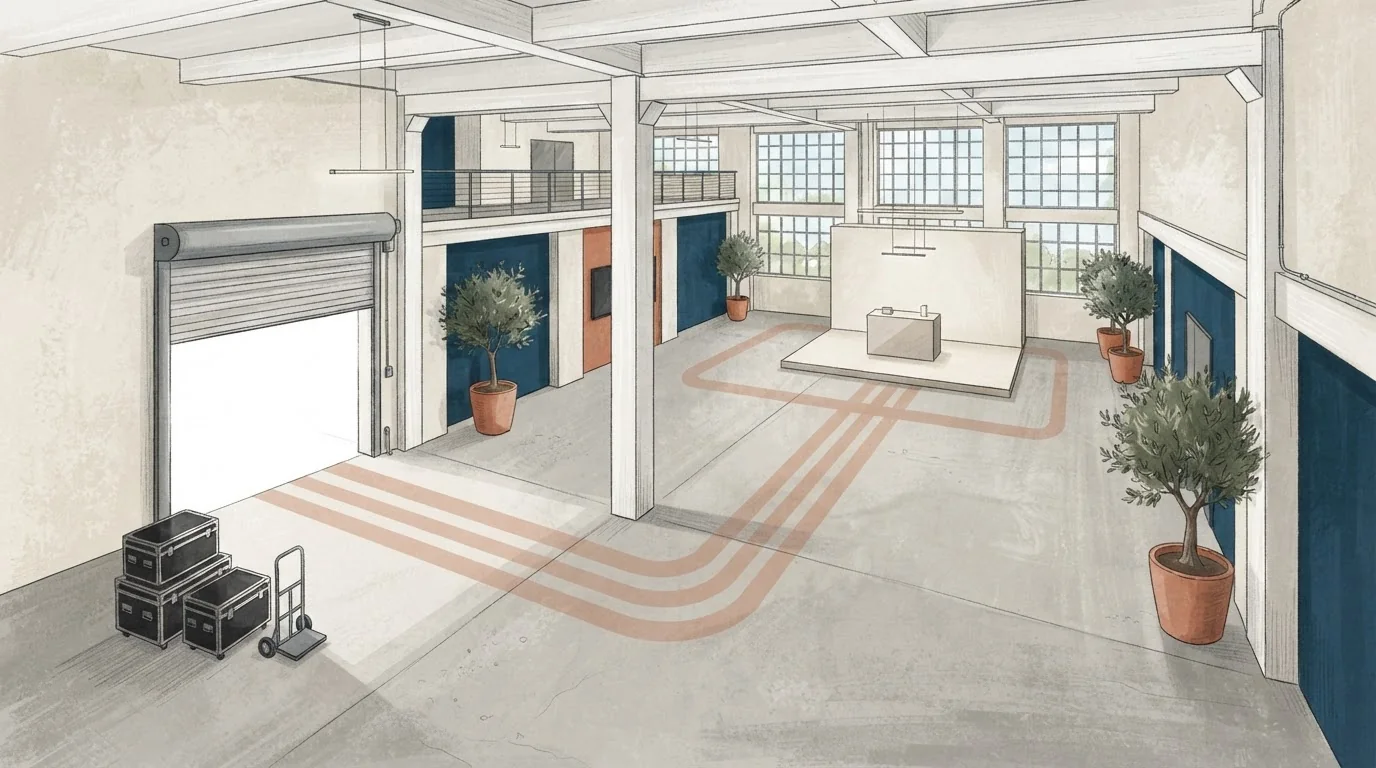
Picture a loaded van outside a promising Athens industrial space. The loading door is 1.2 metres wide, the lift has a 900 kg limit, and the stand you approved arrives in three crates that won't fit through either. Guests are due in four hours. Nobody checked the delivery route.
That is the decision this article addresses. The product has to reach the room before guests do.
Measure the route, not just the room
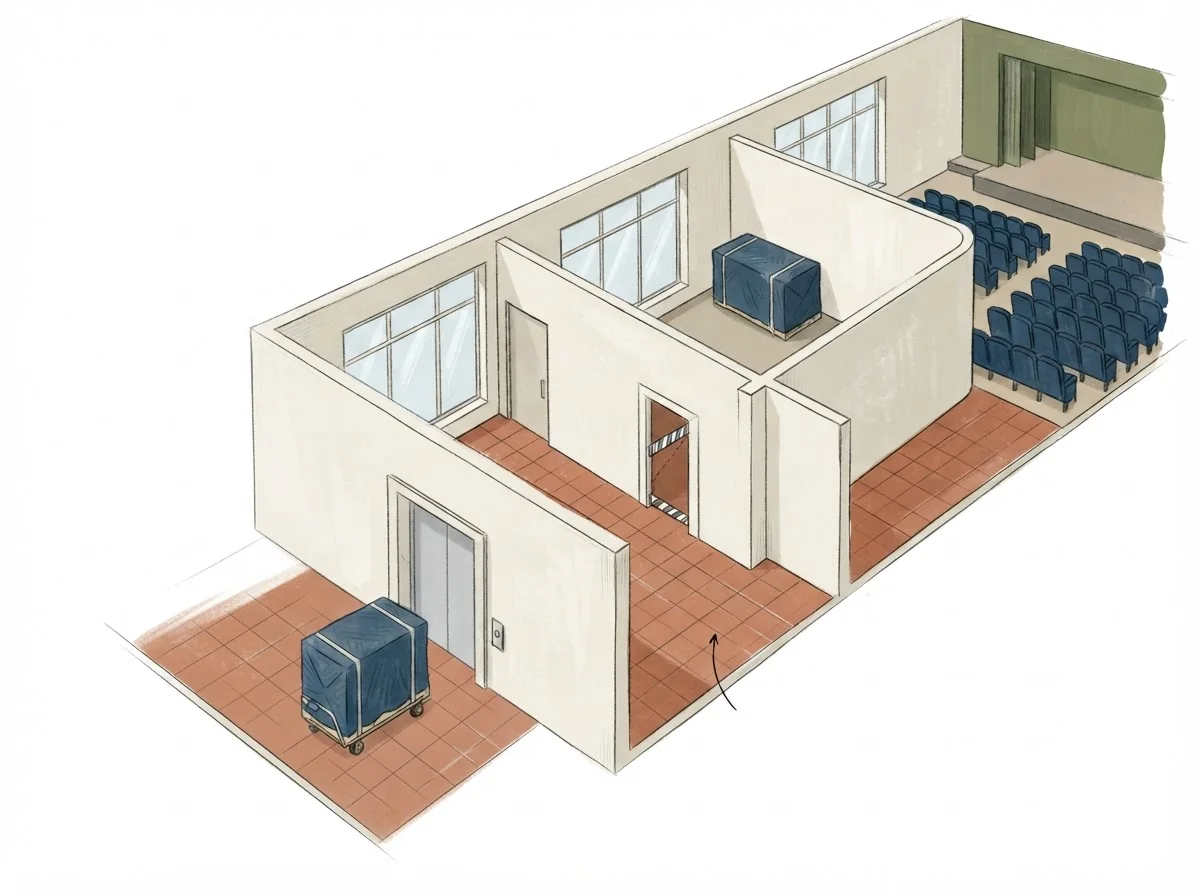
A venue can look perfect in photographs and still fail on access. The route into the room is a chain: street approach, gate or barrier, loading bay, corridor, door, lift or stairs, then the final doorway into the event space. Any weak link stops the delivery.
Ask for measurements in writing. Door and lift dimensions, clear width after doors open, corridor turns, ceiling height at the loading point, and any step or ramp. Do not accept estimates from memory. If the venue cannot measure, arrange a site visit with your supplier or transport company, and bring a tape measure.
Load ratings matter, but never invent them or assume them. Ask what the venue's written documentation states for floors, lifts and loading areas. If documentation does not exist, treat the route as unverified and plan around it.
Permissions, timing and security
Access is not only physical. Ask when vehicles may park at the loading point, whether permits are needed from the municipality or building management, and which hours are allowed for noisy deliveries. Some buildings restrict evening or Sunday access. Get the answer for your exact date.
Security is the other half. Who holds keys or codes? Is there a staffed reception, or does someone from your team need to meet the driver? Can crates stay overnight in a locked store, or must everything leave after the event? Ask what insurance the venue requires for goods left on site, and get that in writing too.
A supplier access measurement checklist
Use this template for each venue you shortlist. Fill it with the venue's own answers, not guesses, and attach photos or a marked-up floor plan where possible.
| Item | What to record | Venue answer |
|---|---|---|
| Street approach | Vehicle height or width limits, barriers, low bridges, narrow turns | |
| Loading bay | Surface, slope, drainage, space to turn a van or truck | |
| Entrance door | Clear width and height when fully open | |
| Corridor route | Narrowest point, turns, protruding fixtures, floor surface | |
| Lift | Internal dimensions, door opening, documented load limit | |
| Stairs | Step count, width, handrail, landing space | |
| Final doorway | Clear width and height into the event room | |
| Storage | Lockable room, size, access hours, responsibility for contents | |
| Permissions | Who approves parking, noise and out-of-hours access | |
| Contacts | Names and phone numbers for access, security and facilities |
Add a column for your largest single item: its dimensions and weight, packed and unpacked. If it does not fit through the narrowest point on the list, the venue fails before the conversation gets creative.
Ask these questions together
Availability and a written quote belong in the same request. Asking only whether a date is free tells you nothing about whether your launch can physically happen there.
Ask about delivery windows, setup and breakdown times, and whether they are included or charged separately. Ask which amounts in the quote are subject to tax as quoted, and which amount the tax applies to. Ask what the venue provides and what you must bring, including power, lighting and any rigging points. Ask whether the venue has hosted launches with comparable production before, without assuming the answer is yes.
For context on how production facilities need their own assessment, Megaron's conference centre describes stage and understage infrastructure, which is a useful reminder that technical spaces are not interchangeable with plain rooms.
When the route changes your shortlist
Sometimes the honest answer is to drop a venue. If the lift limit is below your heaviest crate and there are no stairs you can use, no amount of styling fixes that. If the only loading window is two hours before doors open, your build schedule is already broken.
That tradeoff is real: a venue with awkward access can still work if you reduce what you ship, split deliveries across two days, or use smaller loads that fit an approved delivery route. But those choices affect budget and crew, so make them early, not on the morning of the event.
For a hypothetical example, a 60 guest launch with a two-crate stand and a 1.5 metre wide loading door may fit easily. The same event with a four-crate stand and a 1 metre door may not. The arithmetic, not the style, decides.
Send this to suitable venues
Write one short message you can reuse. Include the event date, guest count, arrival and setup windows, the dimensions and weight of your largest packed item, whether you need vehicle access at the door, whether anything stays overnight, and whether you need power or rigging. Ask for availability, a written quote with tax clearly stated, and the venue's own access measurements. Then compare the answers against the checklist above. If a venue cannot answer the access questions, that is your answer.
Make a separate measurement sheet for the product in its transport packaging. A display object can fit through the door after unpacking while its shipping case does not. Ask the supplier which dimensions include protective packaging, handling equipment and any part that must remain upright. Record the source of each measurement; do not estimate it from a photograph.
Then walk the proposed delivery sequence on the plan. Identify where the vehicle stops, where the team unloads, where packaging waits and where the product is assembled. Ask who can authorize a change if that route is unavailable on the day. This is a coordination exercise, not a substitute for the venue's technical assessment or the supplier's handling instructions.
The return journey deserves its own row in the schedule. Ask whether empty cases can remain on site, when the room must be clear and who confirms collection. A launch can end while the product and its packaging still need several separate tasks. List those tasks against the responsible business before comparing venue offers.
Finally, keep the measurement sheet, room plan and agreed delivery schedule together. Send the same version to the venue and the production supplier. Ask both to acknowledge the parts they control, including any unanswered questions. That gives the event coordinator a usable record instead of a chain of assumptions.
Two useful next steps: The venue site visit: bring the same brief to every room and The hybrid meeting test to run before signing.
Planning questions
What measurements should I collect to ensure the product can be delivered?
Record street approach limits, loading bay, entrance door, corridor, lift, stairs, final doorway, storage, permissions and contacts. Include the largest item's packed and unpacked dimensions and weight. Compare against the narrowest point.
If the venue's lift limit is too low for my crates, can styling or last-minute changes fix it?
Styling cannot solve an unsuitable delivery route. Confirm another approved route or whether the supplier can provide smaller compatible loads. If the product cannot reach the display area within the venue’s limits, choose a different venue or delivery plan.