
What the Athens airport actually offers a group
Athens International Airport sits at Spata, on the eastern side of Attica. Metro Line 3 runs from the airport through central Athens to Piraeus, according to Athens International Airport's public transportation page, and the airport says timetables must be checked for the actual date you travel. Read that line twice if you're planning a late arrival. Beyond the metro, your realistic choices are airport buses, taxis and a chartered coach from a local operator, and each needs checking against your date.
What the airport does not offer is a group desk that holds forty seats for you. Every option is walk-up or pre-booked by you.
The group arrival matrix to fill in before asking for quotes
The working tool is a one-page grid. Rows are your arriving flights; columns are arrival time, terminal, headcount, checked bags, hand luggage, mobility needs, and whether the guest can wait. Guests who can wait are the cheapest variable you own, because a single coach meeting three flights two hours apart costs less than three coaches meeting three flights.
| Flight | Arrives | Pax | Checked bags | Can wait 90 min |
|---|---|---|---|---|
| OA 1 | 09:40 | 6 | 4 | Yes |
| OA 2 | 11:20 | 9 | 9 | Yes |
| OA 3 | 18:05 | 12 | 8 | No |
| OA 4 | 22:30 | 5 | 2 | No |
The flights above are example data. Fill the last column honestly. It decides your vehicle count more than the total headcount does. Sort each arrival cluster onto a separate line, count the vehicles that implies, and only then compare metro, bus, taxi and coach against each cluster. Keep the grid with your event file, because the venue and the coach operator will both ask for it.

Matching metro, bus, taxi and coach to the spread
A tight spread of arrivals within about ninety minutes suits one coach meeting the group at a single point in the arrivals hall. A wide spread suits two or three smaller vehicles, or a mix where early arrivals take the metro into the city and the stragglers get a taxi. Metro works best for guests with one bag each, a fixed event start time in central Athens, and the patience to check the timetable for their date. Taxis work for two to four people with normal luggage who value the door-to-door trip over the per-head cost.
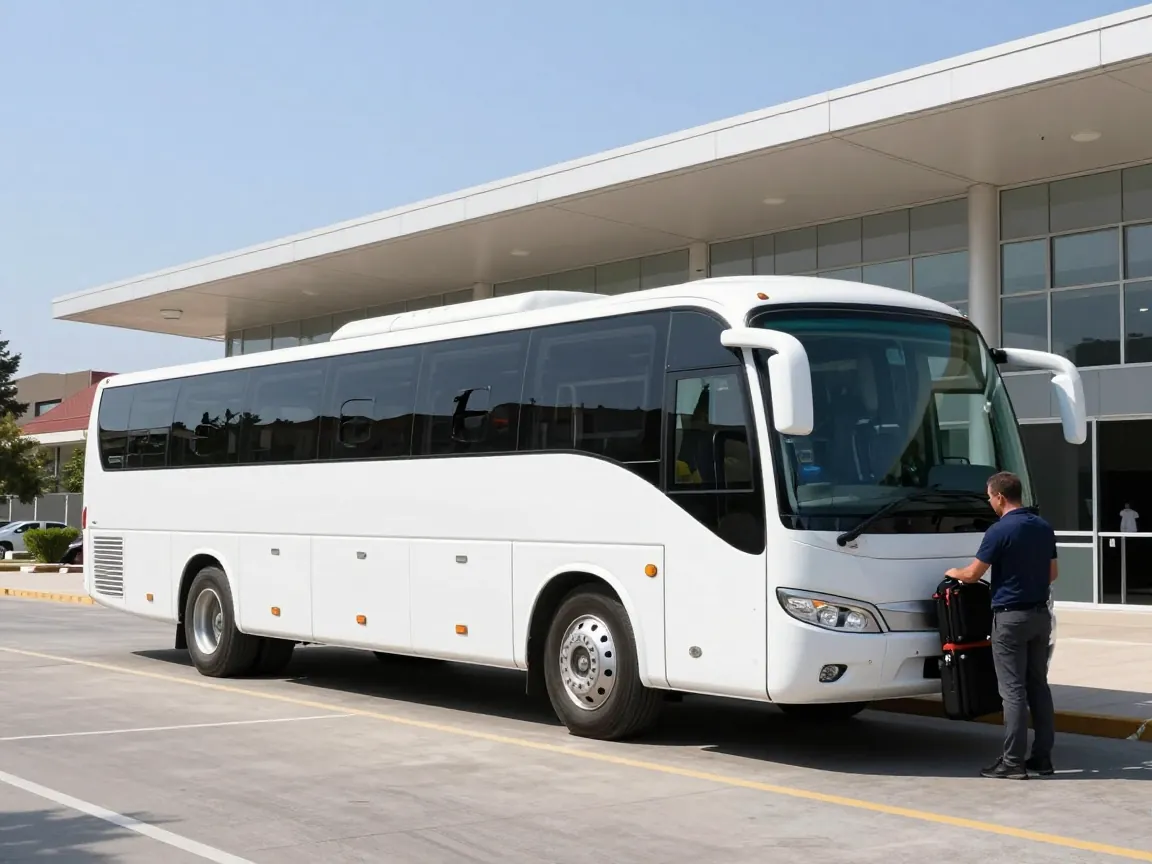
Luggage is the quiet decider. A coach holds everyone but needs somewhere to park at the venue; a string of taxis simply drops and leaves, but costs more per person. Venue location decides which of those matters. Central Athens venues stack up against traffic and parking; venues outside the city centre, including retreat-style properties, favour a coach that stays with the group. If your programme is closer to a multi-day offsite than a single conference day, our team retreat venues and charter guidance covers the coach-on-standby model we prefer for groups that move between sites.
One concession: if your group is under about fifteen people and your venue is central, we'd usually skip the coach entirely. The coordination overhead does not repay itself.
What to confirm with the airport, the venue and the coach operator
Confirm with the coach operator whether the vehicle can wait at the airport, where it stages, and what happens if a flight slips. Confirm with the venue whether a coach can reach the door or must drop at a gate, and whether there is a standing area for drivers. Confirm with the airport the pickup point for pre-booked groups on your date, since road layouts and pickup zones change.
For anything regulatory in this territory, including airport access rules, coach parking restrictions and road closures, confirm current requirements with the competent authority, whether that's the airport or the municipality, before you commit the group to a plan.
A worked pattern for a two-day corporate event
Day one morning arrivals are often tight when delegates book early flights. One coach, one meeting point, one drop at the venue. Day two is looser, and that's where a standby vehicle earns its cost if your agenda has site visits. If your event has a fixed ceremonial start, such as a seated dinner, build the arrival plan backwards from that time and give every guest a named fallback: the metro line, the bus stop or a taxi rank. For events with tight timing and media attendance, the arrival pattern interacts with the room itself, and our notes on press breakfast logistics show how a quick, clean exit shapes the plan.
If the event is festive rather than formal, the transfer pattern changes again, and our guide to Athens Christmas party formats explains how seated dinners and receptions pull guests in at different times.
Questions to send the venue and the coach operator
Send these in writing, in one email, and ask for answers in writing. A written reply gives you something to hold the operator to on the day, and it takes ten minutes to send.
- Can a coach of our size reach the main entrance, and where does it drop?
- Is there a waiting area for drivers, and for how long?
- What is the venue's policy if a flight is delayed and the group arrives late?
- Does the venue have a preferred transfer operator?
- What is the contact number for the person managing arrivals on the day?
Two practical extras before you send anything. Ask the coach operator how long the driver can legally stay with the vehicle at the airport, because waiting time is usually the line item that surprises planners. Ask the venue whether arrivals can be staggered through a side entrance if your group lands in one wave, which keeps the lobby clear and the registration desk calm. Neither answer changes your vehicle count, but both change your day-of script.
Before you finalise anything, walk the arrival sequence once more with the person who will actually stand in the arrivals hall. They are the one who will spot the guest whose flight landed early, the one whose bag did not, and the one who needs a taxi rather than a seat on the coach. Give that person the matrix, the venue contact and the operator contact in one message, and agree a simple rule for when to stop waiting and move the group without the stragglers.
Send your headcount range, your arrival dates and times, and a two-line brief on the event itself, and suitable venues and operators can respond with a plan that fits your group rather than a generic quote.
Planning questions
When is the Athens metro better than a coach for a corporate group?
When arrivals are spread across the day, each guest has one bag, and the event sits near a central Athens station. Check the timetable for your exact date, because service patterns vary. Groups of forty with heavy luggage should charter instead.
How early should we book coaches for airport transfers?
Build the arrival matrix first, then approach operators once vehicle numbers are fixed. The matrix, not the headcount, tells you how many vehicles you need. Leave enough lead time for the operator to confirm staging and waiting arrangements at the airport.
What should we ask the venue about coach access?
Ask in writing whether a coach can reach the entrance, where it drops, whether drivers can wait on site, and who manages arrivals on the day. Get the answers in writing before you brief the coach operator.