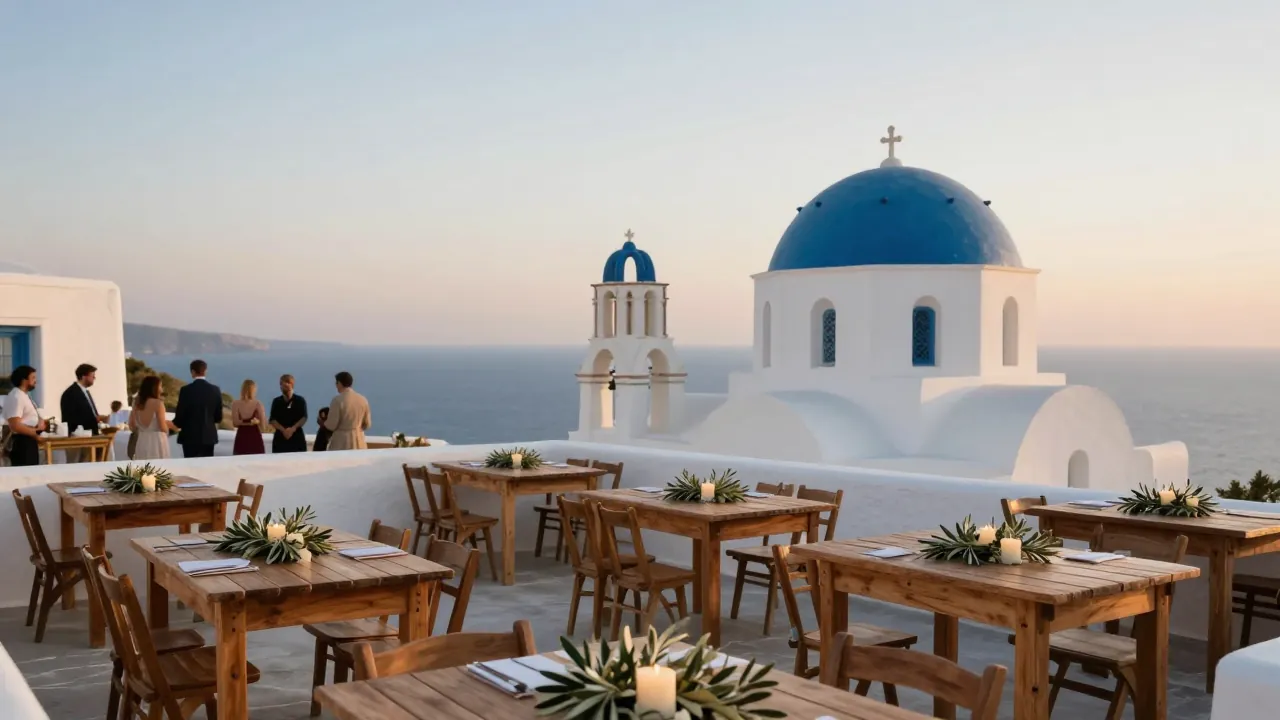
The ceremony explanation: what happens, in what order, in both languages
The Greek Orthodox ceremony is a sequence of actions, not a lecture, and that is your ally. Guests who cannot follow the words can still follow the movement if someone tells them what to watch for. Ask your priest, well before the wedding, whether a short printed order of service in both languages is welcome, and whether a bilingual booklet or a single explanatory card suits the parish better. Practice varies by parish, so ask before you print anything.
One point is a planning fact, not a preference. The Greek Orthodox Archdiocese of America notes that in mixed Orthodox and non-Orthodox marriages the non-Orthodox partner must have been baptized in water in the Name of the Father, Son and Holy Spirit. That affects paperwork, so raise it early. In Greece, the competent parish and registry office confirm how it applies to your case.
For the guests, we like a one-page ceremony card: five or six numbered moments (procession, exchange of rings, crowning, common cup, the walk) with one line of explanation each, Greek on the left, English on the right. The person holding that card stops wondering whether to stand or sit.
One master of ceremonies beats two parallel weddings
The biggest structural mistake is running two programmes: one for the Greeks, one for everyone else. Split the room at dinner and it can stay split all night, because each table has its own conversation and neither needs the other. The fix is boring and effective. Name one bilingual host, or two co-hosts who stand together, and give them a written script that covers every transition: welcome, first speech, dinner service, cake, first dance, dancing open to all.
That script should say, in plain terms, which language each speech is in and whether there will be a translation. Speeches are where bilingual weddings are won or lost. A ten-minute toast in Greek followed by a shrug towards the English speakers, or the reverse, produces polite silence. Three to four minutes per speech, delivered in one language with a short spoken summary in the other, keeps both halves awake.
If your celebration involves a second rite on the same day, our guide to one celebration, two ceremonies explains why the reception brief needs both ceremonies written into it before the invitations go out.
Signage, menus and the small print guests actually read
Signs and menus do more quiet work than any speech, because guests read them while they are standing, waiting or deciding. Translate everything a guest has to act on: the parking direction, the seating plan, the welcome sign, the menu, the bar list, the order of events, and the names of the dishes that need a warning line (nuts, shellfish, pork, alcohol in desserts). Keep the two languages side by side on the same card rather than on two separate cards, so nobody has to guess which one applies to them.
Seating deserves its own decision. Bilingual tables, where every table can hold a conversation in Greek and in English, beat language-based tables, in our view. It is more work to arrange because you cannot sort guests by the language they speak, so start with who knows whom and where the two or three fluent connectors in your circle sit. If you have guests who speak neither Greek nor English, add their language to the key signs, or ask one relative to be their person for the evening.
A bilingual-wedding checklist by moment of the day
| Moment | What needs two languages | Who owns it |
|---|---|---|
| Arrival and parking | Direction signs, welcome sign, ushers briefed in both languages | Bilingual host |
| Ceremony | Order-of-service card, standing and sitting cues, explanation of the crowning | Couple with the priest's agreement |
| Photos and drinks | Simple instruction card: where, when, who is being photographed | Photographer plus host |
| Dinner | Menu, allergy and dietary notes, seating plan, table names | Caterer plus host |
| Speeches | Written order, language of each toast, who translates and how long | Master of ceremonies |
| Music | Announcements before each set, first dance context, request cards | DJ or band leader |
| Late evening | Taxi and shuttle instructions, next-day plan, thank-you note wording | Host |
Print the checklist, or paste it into the same document as your run sheet, and give a copy to every supplier who touches the guest experience: caterer, DJ, photographer, transport.

Music, dancing and the awkward first sets
The dance floor is where language stops mattering and confidence starts mattering. A Greek band will usually have the Greek guests up within the first few songs. Visitors will join if someone shows them the steps and if the first few songs are ones everybody recognises. Ask the band leader or DJ to announce the next set in both languages, and to name the first dance before it plays, so nobody wonders what they are watching.
Know where to stop: you cannot translate everything, and you should not try. The moment one host starts interpreting every side conversation, the reception turns into a translation service and the couple never eats. Choose the five moments that carry meaning (the ceremony explanation, the two or three speeches, the cake, the first dance) and let the rest of the evening be a party where people point, laugh and manage. A listing such as Ktima Diamond in Kifisia, which its website presents for weddings, baptisms and corporate functions, combines indoor spaces with an outdoor area; mixed indoor and outdoor layouts are exactly where good signage earns its keep, since guests move between two sound environments. Capacity, pricing and accessibility details are not provided in the listing, so ask about each directly.
Budget also shapes the language plan. If you are trimming the guest list, our notes on a small wedding and its minimum spend explain why fewer guests can mean a tighter brief rather than a simpler one, and translation is part of that brief.
Questions to put to the venue, the priest and every supplier
Before booking anything, ask each supplier the same three questions in writing: do you have bilingual staff on the night, who writes the announcements, and can you deliver printed menus and signs in both languages as part of your service. Add a clause to the venue contract naming who supplies and who approves the bilingual signage, and when. Confirm the ceremony requirements with the parish, and the civil paperwork with the registry office or consulate, because those rules can change and neither a venue nor a blog can confirm them for you.
Then build your own short brief: date, headcount with a labelled example, the two languages in play, and the five moments you want translated. Send it to the venues you are considering and ask how they would handle each moment.
Planning questions
Should we print the whole ceremony in both languages or just a summary?
A summary works better. Five or six numbered moments with one explanatory line each, Greek beside English, fits on one card and gets read. The full liturgical text in two columns is rarely followed and costs more to print.
How long should a bilingual speech be before guests lose interest?
Keep each toast to three or four minutes in one language, then a short spoken summary in the other. Two long speeches with translation can push the dinner service back and leave half the room waiting rather than listening.
Who should translate on the night, a guest or a professional?
Use a named bilingual host for announcements and the key speeches, not a guest pulled from a table. One person with a written script keeps the flow, while well-meaning volunteers tend to disappear once the dancing starts.