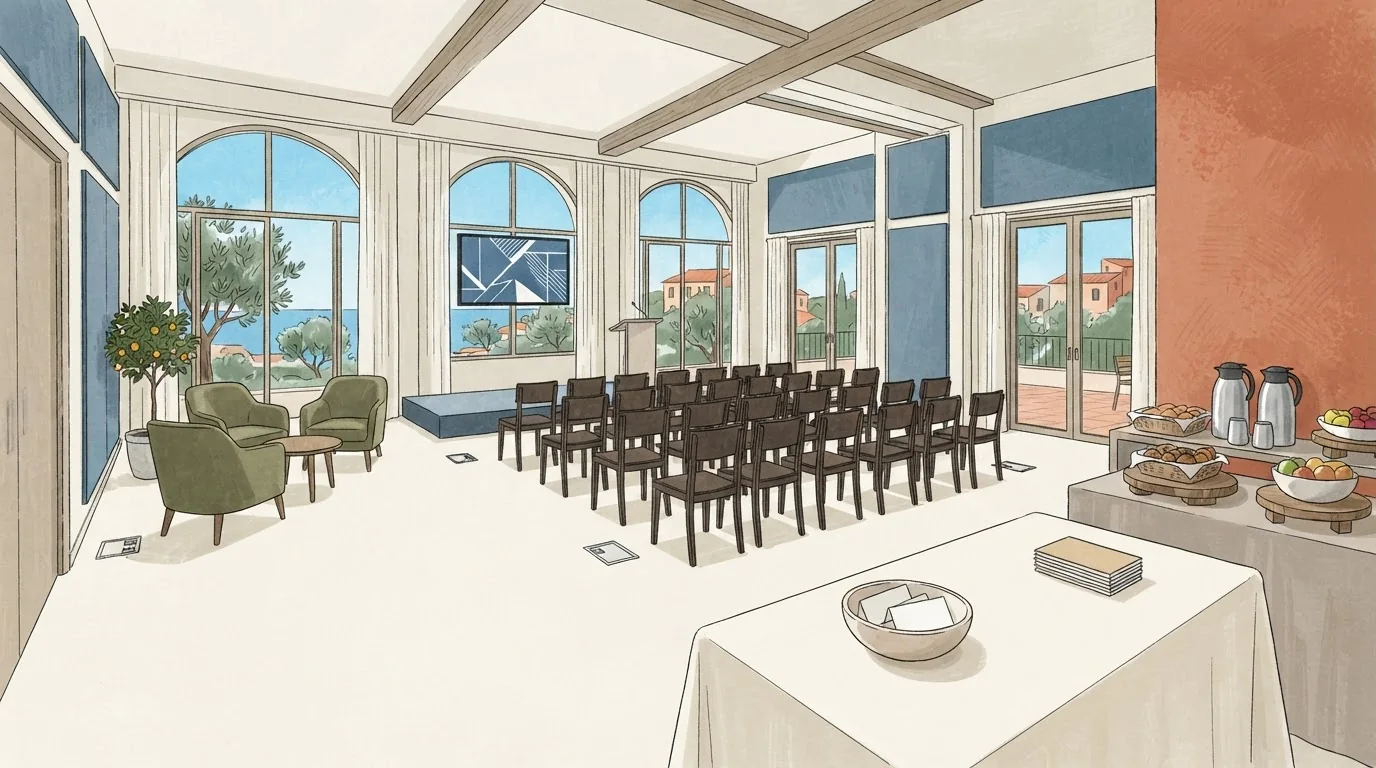
The rest of this article is about the four things that decide whether the room works: check-in, sound, the interview corner and power.
Check-in should take minutes, not a queue
A press breakfast usually fails at the door. One person with a list, a phone that will not load the list and a room number nobody wrote down creates a bottleneck. Fix it before you fix the coffee.
Ask the venue what the arrival route looks like from the street or car drop-off to the room. Is there a lift, a second entrance, a cloakroom? If guests arrive in the same ten minutes, one desk is not enough. Two people with two printed lists beat one person with a tablet.
Give journalists the room name in the invitation, not just the venue name. If the venue has several rooms with similar names, ask for the exact label to print. Put a small sign at the entrance and another at the lift. That is not decoration; it is the difference between a guest arriving calm and a guest arriving annoyed.
Sound is the part you cannot fix later
A breakfast room with hard walls, a coffee machine and a serving station is a bad place for a speech. If the announcement matters, ask for a room with soft surfaces or a separate presentation area away from the buffet.
Ask these questions in writing:
- Is there a fixed sound system, and who operates it?
- Can we test it at the same time of day as the event?
- What happens if the room next door has its own event?
- Is there a microphone for questions, or only for the speaker?
- Where do we plug in a laptop for slides?
A handheld microphone for the speaker and a second one for questions is more useful than a complicated setup nobody knows how to run. If the venue has an in-house technician, ask whether that person is included or quoted separately. Do not assume.
Background music is optional. If you use it, keep it low enough that two people at a table can talk without raising their voices. A press breakfast is a working event, not a party.
The interview corner is the real product
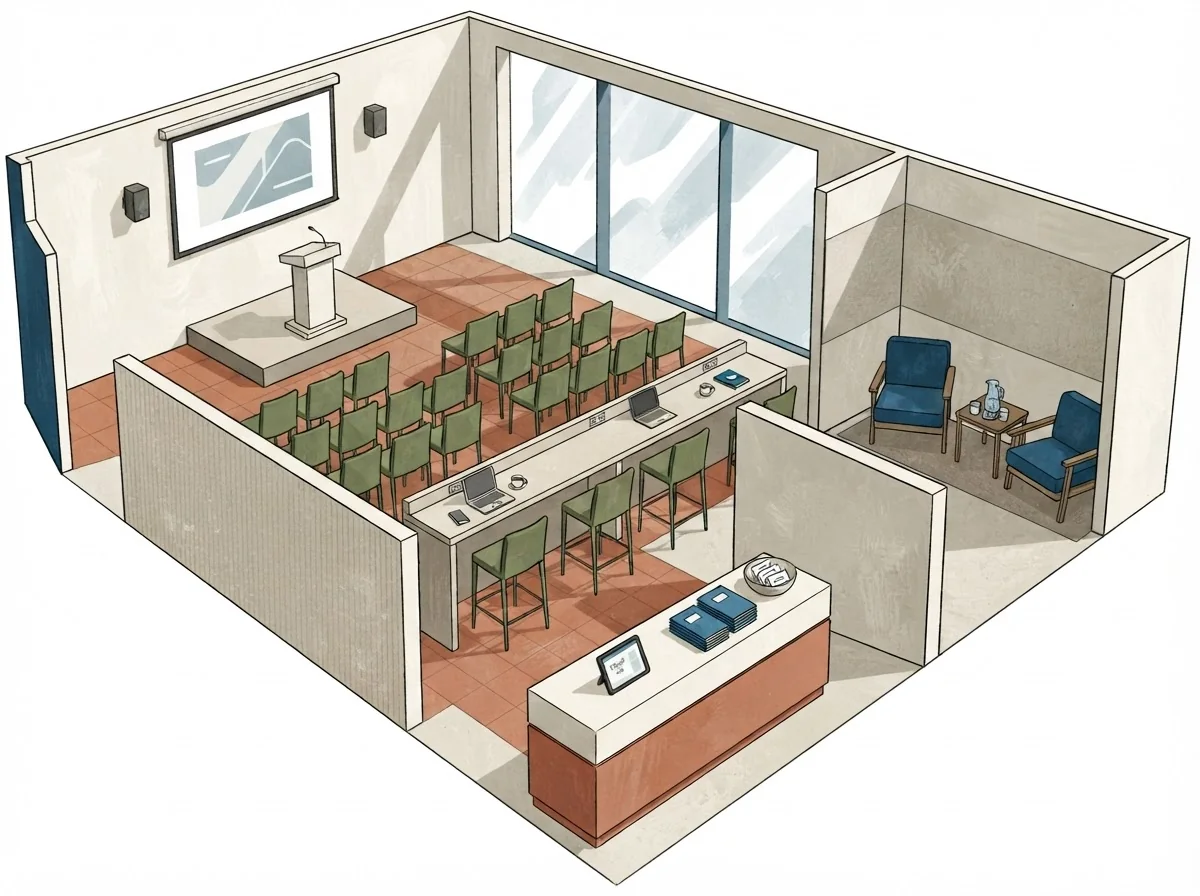
Most of the useful coverage comes from the ten minutes after the announcement, not the announcement itself. Plan a corner where a journalist can sit with your spokesperson, away from the buffet and away from the door.
You do not need a full studio. You need a table, two chairs, a neutral wall and enough light. If the venue can provide that without moving furniture during the event, you have solved half the problem. Ask if the corner can be reserved for the whole breakfast window.
If several journalists want the same spokesperson, set short slots. Ten minutes each is enough for a quote and a photo. Write the slot times on a card and give one to each guest. That small piece of paper prevents a crowd around one person.
Power, Wi-Fi and the practical details
Journalists carry phones, laptops and recorders. Ask where the power sockets are and whether extension leads are available. A room with sockets only along the wall means people will sit away from the interview corner.
Wi-Fi matters if anyone needs to file early. Ask for the network name and password in advance, and test it from the room, not the lobby. If the venue cannot guarantee a stable connection, say so in the invitation so guests can plan.
A coat area near the entrance is more useful than a coat area at the far end of the room. A bin near the exit is more useful than a bin near the stage. Small things, but they decide whether people leave quickly or linger looking for a place to put a cup.
An illustrative 75-minute press breakfast plan
This is an example, not a rule. Adjust the times to your own announcement and guest list.
| Time | What happens | Who is responsible |
|---|---|---|
| 0:00-0:10 | Check-in, name badges, coffee and a printed one-page fact sheet | Two hosts with printed lists |
| 0:10-0:15 | Guests move to the presentation area; sound check is already done | Venue technician or your AV contact |
| 0:15-0:30 | Welcome, short announcement, one speaker only | Spokesperson |
| 0:30-0:35 | One or two questions from the room | Moderator with a handheld mic |
| 0:35-0:55 | Interview corner slots; buffet stays open | Spokesperson plus one media handler |
| 0:55-1:10 | Photos, informal conversations, second coffee | Your team |
| 1:10-1:15 | Thank-you, reminder of the press contact, clear exit route | Hosts at the door |
If your guests have short attendance windows, put the announcement earlier in the plan and keep the interview corner open from the start. A journalist who arrives at minute 40 should still find a spokesperson, a quiet table and a power socket.
What to send to venues
Before you ask for availability, write a short brief. It should include the date, the time window, the approximate guest count, whether you need a presentation area and an interview corner, and whether you need sound equipment. Ask for a written quote that separates room hire, food and drink, equipment and any staff costs. Ask what time you can access the room for setup. Ask who is the on-site contact on the day.
The venue should confirm what is included and what is quoted separately. If a term is unclear, ask which amount it applies to. Do not assume that a hotel breakfast package includes the microphone or the technician.
For a narrow fact to keep in mind: Ecali Club lists board meetings, training, team building, product presentations and corporate family events in its business offering. You can see that list on the Ecali Club business events page. That is one venue's published scope. It is not a claim about our collection or about what any other venue offers.
The difference is the clock, not the checklist.
Send the venue your brief, your run of show and your questions. Ask for availability and a written quote together. Then compare the answers side by side, because the room that looks right in a photo may not be the room that lets a journalist leave in 35 minutes with everything they came for.
Two useful next steps: A 12-person Athens board meeting needs a table test and The hybrid meeting test to run before signing.
Planning questions
How should I adjust the timeline when some journalists can only stay for a short window?
Put the announcement early and keep the interview corner open from the start. A journalist arriving later in the programme should still find a spokesperson, a quiet table and a power socket.
What should I ask a venue about sound and power before booking?
Ask in writing: fixed sound system and operator, testing at event time, microphone for questions, laptop plug-in, socket locations and extension leads. Request a written quote separating room, food, equipment and staff costs.