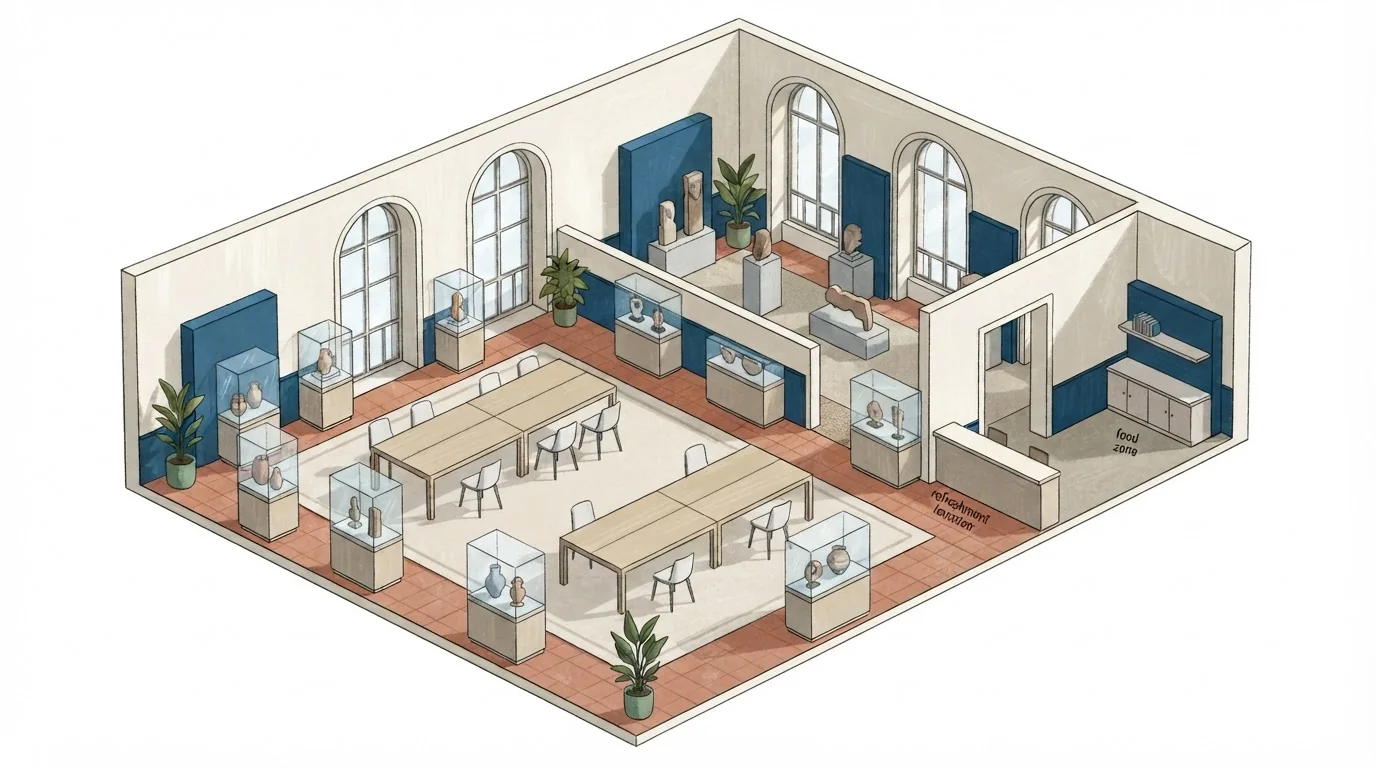
Start with the room, not the guest count
Museums rarely sell one undivided space. They sell a gallery, a lobby, a courtyard, a lecture room, a shop floor after closing, or a combination that changes throughout the evening. Ask for a written room list with the permitted use of each one. Then ask what happens between rooms: does a cocktail hour in the lobby end at a fixed time, and who moves guests into the next space?
A practical way to test this is to describe your event as a sequence. Example: welcome drinks for 80 guests from 19:00 to 20:00, seated dinner for 60 from 20:30 to 23:00, and a DJ set from 23:00 to 01:00. Ask the venue to write the sequence next to the rooms it can offer. If the timing doesn't fit, you'll see it on paper rather than during the event. Repeat the exercise for the setup day too, because load-in often has a different room list than the event itself.
Gallery boundaries and food zones
Food and drink are usually the first restrictions you'll meet. Some museums allow drinks in galleries but not red wine. Some allow catering only in a separate courtyard or tented area. Some allow nothing on the gallery floor. Ask for food and drink zones in writing, including where caterers can set up, where they can store crates, and where they can wash equipment.
Don't assume the venue's preferred caterer solves this. A caterer may know the building and still need written approval for open flame, chafing dishes, or a coffee machine's power draw. Ask whether the venue requires its own staff to serve alcohol, and whether that changes your supplier list. Ask where guests will queue, sit and leave coats, because those three spots often sit outside the approved zone.
Installation, rigging and load-in
Installations are where museum rules get specific. Ask about wall fixings, floor protection, hanging points, rigging, cable routes, and whether you can use tape, pins, or adhesive. Ask what time load-in starts and whether it must happen outside public hours. Ask if the venue needs to approve the technical plan before the date, and how many days in advance.
A useful question that saves arguments later: who is responsible for damage to a listed surface, and what deposit or insurance does the venue require? Get the answer in the written quote. Ask about noise limits too, since a late DJ set may collide with residential neighbours or with a conservation requirement.
Staff escort and after-hours access
Many museums require a staff member or security guard to be present in each room where guests are allowed. That person may be included in the hire fee or billed separately. Ask how many escorts are required, what their hours are, and whether they stay for load-out and load-in. Ask if your own production team can move through the building unescorted. If not, add waiting time to your schedule.
After-hours access is a separate permission. Ask when the building is exclusively yours, when public visitors leave, and when your suppliers can enter. If the museum stays open during your setup, your team will be working around visitors. Ask whether the museum can close a single gallery early for you, and whether that changes the fee.
Permissions checklist for museum hire
| Item | What to ask | Written answer |
|---|---|---|
| Rooms | Which rooms are available for my date, format and guest count? | |
| Room sequence | What is the permitted use and time window for each room? | |
| Food and drink | Where can catering set up, serve and store? | |
| Alcohol | Can we serve alcohol, and does the venue require its own staff? | |
| Install and rigging | What fixings, tape, hanging points and cable routes are allowed? | |
| Load-in and load-out | What are the access times, doors and lift limits? | |
| Staff escort | How many escorts, for which rooms, and for how many hours? | |
| After-hours access | When is the building exclusively ours? | |
| Insurance and deposit | What cover and deposit does the venue require? | |
| Technical approval | Who approves plans, and by when? | |
| Suppliers | Are there approved supplier lists, or can we bring our own? | |
| Signage | Can we place temporary signage, and where? |
Use this as a working document. Send it to the venue and ask them to fill in the blank column. A museum that answers these questions clearly is easier to plan with than one that only sends a hire fee. Keep a copy of the completed version attached to the quote, so any later conversation starts from the same page.
Thessaloniki specifics and the quote
Thessaloniki has a range of event venues with different histories, facilities and settings, as the Thessaloniki Convention Bureau venue listing shows. That variety is useful, but it also means you can't apply one museum's rules to another. Ask each venue directly, and compare answers side by side.
When you request a quote, ask for it as a room-by-room breakdown. Include hire fee, staff, security, cleaning, technical support, and any catering commission. Ask whether tax is included and which amount it applies to. Ask what the cancellation terms are and what happens if the museum changes its exhibition schedule. If a room is unavailable on your date, ask for the next available date in writing.
What to send venues
Email three to five museums with the same short brief. Include your preferred date and a backup, your event type, your guest count, your ideal room sequence, whether you need catering and alcohol, your load-in window, and your budget range. Ask each venue to confirm which rooms are actually available and to send a written quote with the permissions checklist filled in. That single email will tell you more than a site visit to a room you may not be allowed to use.
Two useful next steps: An art-gallery reception should protect the viewing space and The venue site visit: bring the same brief to every room.
Planning questions
What should I ask a museum about room sequence before planning my event timeline?
Ask for a written room list with permitted use and time windows for each space. Then describe your event as a sequence and ask the venue to match rooms to each phase. If the timing doesn't fit, you'll see it on paper.
What should I clarify about staff escorts and after-hours access for a museum event?
Ask how many escorts are required, for which rooms and hours, and whether they cover load-in and load-out. Also ask when the building is exclusively yours and when suppliers can enter. If your team can't move unescorted, add waiting time.