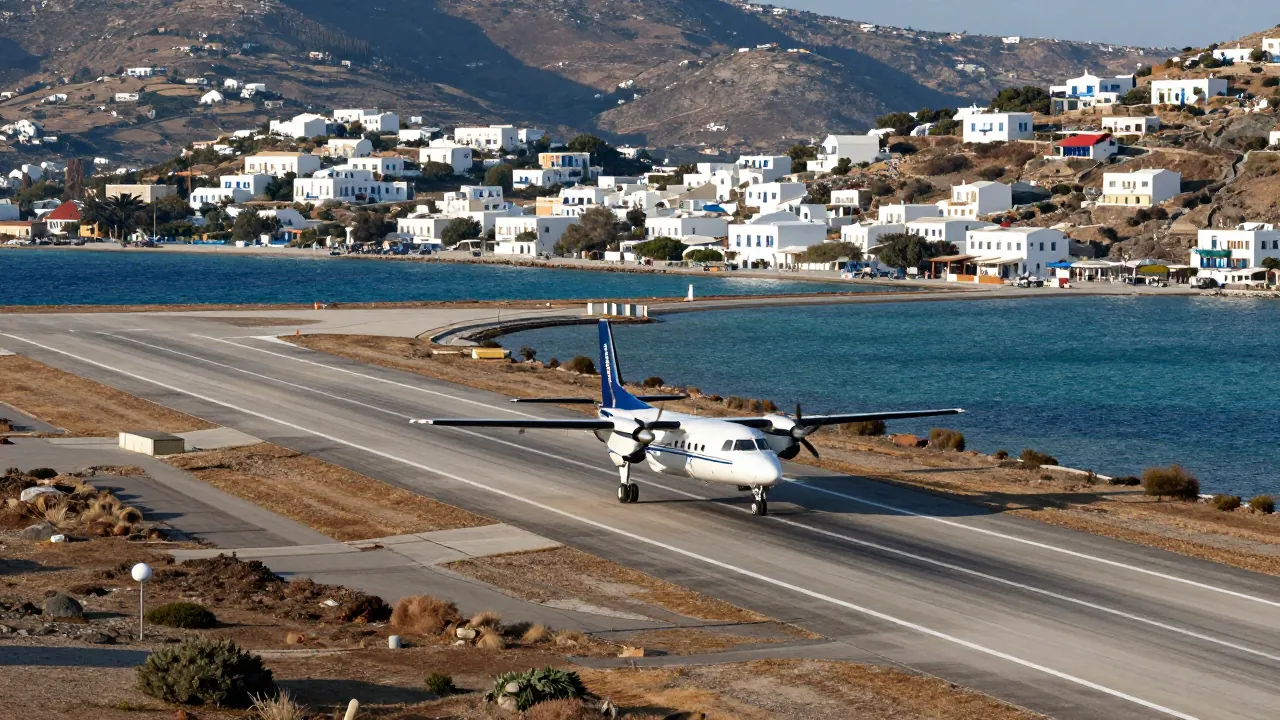
The two routes: direct island landing or Athens connection
A direct international flight to an island airport is quicker on paper and riskier in practice. It removes the Athens leg, but it usually means fewer frequencies per week, smaller aircraft, and a single daily rotation on some routes in shoulder season. If that one flight is cancelled, your guest has no obvious same-day alternative on the same airline pair.
A connection through Athens adds a transfer, a second boarding and a baggage handover risk, but it buys frequency. Multiple daily options between Athens and the larger island airports mean a missed morning flight can often be rebooked by evening. For guests who have never travelled in Greece, the Athens connection is also easier to explain over email: one ticket, one arrival point, one domestic terminal.
Fraport Greece lists fourteen regional airports in its network, among them Thessaloniki, Corfu, Chania, Rhodes, Kos, Mykonos, Santorini, Kefalonia, Zakynthos, Skiathos, Samos, Mitilini, Aktion and Kavala. That list is a starting point, not the whole picture: check which of these airports actually has a seasonal direct route from your guests' cities, because that decides who can skip Athens.
What the island airport choice does to your weekend timetable
An event built around direct arrivals usually runs Friday-to-Monday. Guests land across a narrow band of hours, transfers bunch up, and the welcome dinner needs to start late enough to catch the last landing. That is workable, but it makes you hostage to one flight per market.
An event built around Athens connections usually stretches to Thursday-to-Tuesday. Guests trickle in over two days, you host a soft evening on the first night, and the main event sits in the middle. It costs guests an extra night of accommodation, which is a real objection, and we say so plainly: not every couple should ask for it.
Our honest view: the island airport is tempting for the romance of the arrival, and that choice can leave a couple spending the weekend managing flight delays. The Athens connection is duller and more forgiving. Pick the one that matches your guest list, not your mood board.

A routing table you can send to guests
Fill this in before you send save-the-dates. The buffer column is the time between a guest's scheduled landing and the first event they must attend. The buffers are our suggested planning margins, not airline guidance.
| Origin market | Arrival airport | Connection | Realistic buffer | Notes |
|---|---|---|---|---|
| Direct-flight city | Island airport | None | 3 to 5 hours | Few frequencies; check the weekly schedule, not just the day |
| Any major hub | Island airport via Athens | One, same ticket | 5 to 8 hours | Protects against a missed first leg |
| Regional city | Athens then island | One or two | Overnight in Athens | For early-morning island departures |
| Domestic Greek city | Athens or direct | Varies | 3 hours | Ferries can substitute on some routes |
| Long-haul | Athens then island | One, with a hotel night | Full day | Jet lag plus a transfer is a bad combination |
Two rules sit under the table. First, never let a guest's first event fall on the same day as a long-haul arrival. Second, if your venue is on Santorini and the listing is in Fira, remember that the last stretch from airport to hotel is on island roads, not motorway. Athina Luxury Suites sits in Fira, according to its listing, with suites facing the caldera and a restaurant on site, which is the kind of address where a late arrival still finds food nearby.
Athens as a deliberate overnight, not a punishment
A forced Athens layover becomes a feature if you plan it. Guests who overnight near the airport or in the city centre arrive at your island relaxed, and you stop fielding messages about missed connections during your own welcome dinner. Build one Athens night into the routing for long-haul guests and for anyone connecting through a different airline.
If your event is on Crete, the base decision comes before the venue shortlist, and we cover that sequencing in our guide to choosing a guest base for a Crete wedding. The same logic applies anywhere with more than one arrival airport.
Weather, delays and the backup that isn't about the venue
Summer meltemi winds and winter storms can disrupt island airports, and small aircraft are more exposed to crosswinds. Your event backup therefore needs a transport clause as well as a rain plan: who tells guests about a delayed flight, who holds the welcome dinner, and who absorbs a transfer that runs two hours late. We wrote a separate piece on giving the weather backup its own floor plan, and the routing table above feeds straight into it.
For anything regulatory, including whether a ceremony can proceed at a given site and what documentation guests need, confirm current requirements with the competent authority: the municipality, the parish, the registry office or the consulate. Rules and processing times change.

Questions to settle before you book anything
- Which airports can your guests actually reach nonstop from their home city?
- How many flights per week serve that island in your event month?
- If the direct flight cancels, what is the same-day alternative?
- Who is the named person answering flight questions during the event week?
- Does your venue or planner offer a fixed transfer window, or is it per arrival?
- Are any guests travelling on separate tickets, where a missed leg is not protected?
- What is the latest arrival time that still allows dinner?
Send us the brief and we will match the routing to the venue
Tell us your guest headcount, your event date and the main cities your guests fly from, and we can point you to venues whose transfer patterns and room counts fit that shape. The routing table comes first. The venue shortlist follows.
One last practical step: once the routing table is filled in, send it to the venue with the guest list. A venue that can see when the first and last guests land can plan the welcome evening and the transfer windows around real times, rather than around a single assumed arrival that only half your guests will match.
Planning questions
Should guests fly directly to the island airport or connect through Athens?
Direct flights remove a transfer but often run once daily, so a cancellation leaves few same-day options. Athens connections add a leg but bring frequency and easier rebooking. Choose per guest market, and give long-haul travellers an Athens overnight before the island leg.
How much buffer time should guests have before the first event?
Treat the buffer as the gap between scheduled landing and the first event a guest must attend. A direct island arrival needs several hours; a connected arrival needs more; a long-haul arrival should never share a day with the first event.
Which Greek islands have airports that can take international arrivals?
Fraport Greece's network of fourteen regional airports includes island airports such as Corfu, Chania, Rhodes, Kos, Mykonos, Santorini, Kefalonia, Zakynthos, Skiathos, Samos and Mitilini. It is not a full list of island airports, so check current seasonal routes from your guests' cities for your event month.