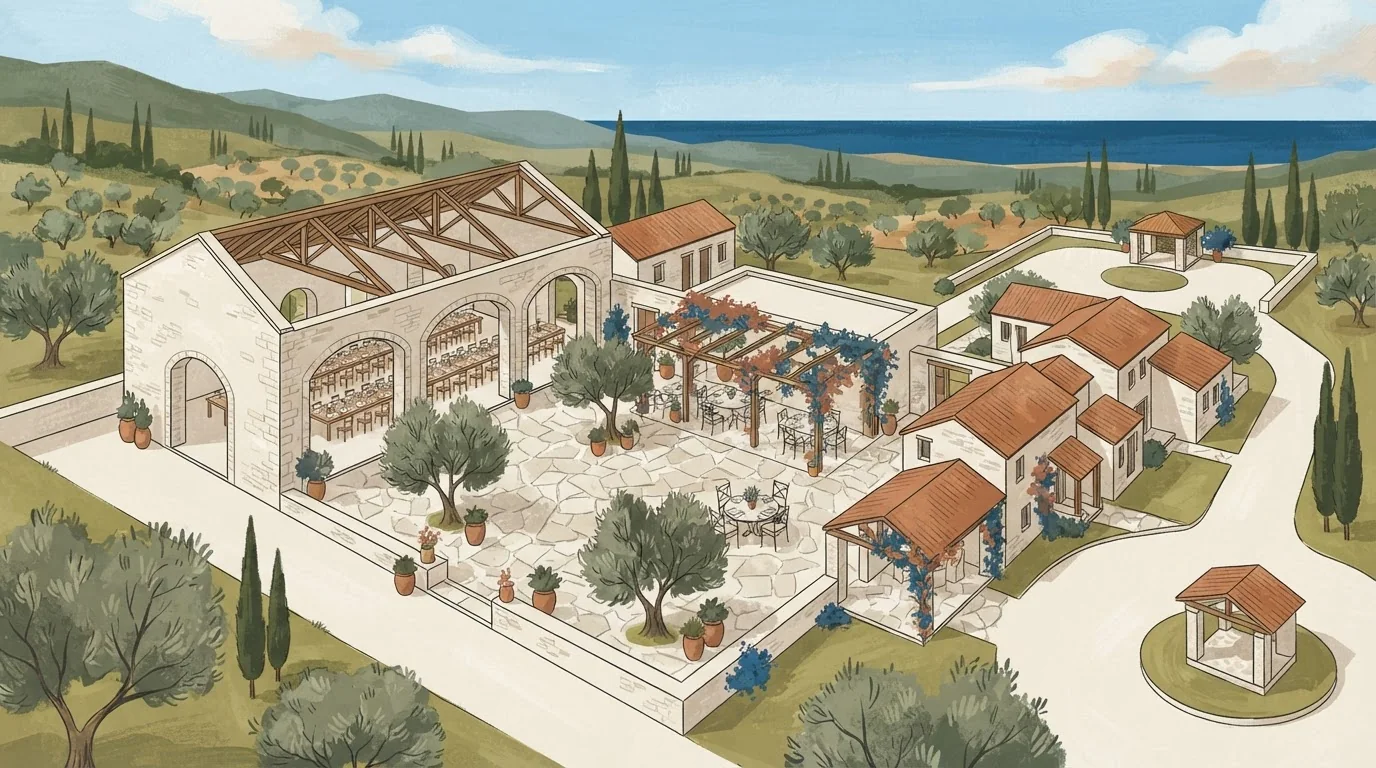
The Peloponnese is a peninsula with distinct sub-destinations. Visit Greece lists Nemea, Monemvasia, Kalamata and Pylos as separate destinations within the region. If your shortlist spans more than one of those, the weekend plan is probably two plans wearing one hat.
Before you go further, decide what you are actually comparing. If you have not yet narrowed the property type, start with event estates so you know what kind of building you are asking about. Then keep the map honest.
The property is not the weekend
A private estate can host a dinner, a ceremony or a long lunch. It rarely hosts everyone's bed, every meal and every airport run. So write down the four pins that make up the trip:
- the property itself
- where guests sleep
- where you eat when you are not at the property
- where the vehicles actually collect people
If those four pins sit in different towns, the weekend works only if you plan the movement between them. If they sit close together, you have room for spontaneity. Neither outcome is automatically better. Dense plans suit some families; loose plans suit others.
Ask the property which of the four pins it can genuinely cover, and which it cannot. A venue that says "we do dinner, but guests sleep in the village" is more useful than one that promises everything vaguely. Vague answers are the main reason a reunion weekend turns into a logistics exercise nobody volunteered for.
Read the region as separate destinations
A shortlist that includes both a Nemea property and a Pylos hotel is not a shortlist. It is two possible weekends. That is fine, but compare them as alternatives, not as one itinerary.
Use the regional split to your advantage. Group your options by sub-destination first, then compare within each group. You will spot quickly whether your guest list can realistically converge on one base. If it cannot, say so early, because that changes the whole shape of the weekend.
A location-first shortlist worksheet
Fill this in before you request quotes. One row per candidate property. Leave the travel column blank unless a venue or hotel gives you a figure in writing.
| Candidate | Sub-destination | Guest sleep base | Meal locations | Transfer pickup point | Travel source (who told you, and when) | Open question |
|---|---|---|---|---|---|---|
| Estate A | ||||||
| Estate B | ||||||
| Hotel option 1 | ||||||
| Hotel option 2 |
Two rules keep the worksheet useful. First, do not fill the travel column with estimates from a maps app. Second, do not let a venue's own description stand in for a written answer about pickup points. The worksheet is not a decision by itself. It is a way to see which options are actually comparable and which are not.
Hotels, meals and the gaps between
Families often split: some want the estate, some want a hotel with a pool and a lift. That is a practical arrangement, not a compromise. What matters is the gap between the two.
Ask each hotel three things: how guests get to the estate, whether the hotel can hold a group breakfast, and what happens if people arrive at different times. Ask the estate three things: whether outside guests can join for meals, whether the kitchen can handle a group, and which entrance vehicles should use.
The logic travels; the pickup points do not.
Transfers: ask for pickup points, not drive times
This is where well-meaning plans fall apart. A venue may be "close" to an airport on a map and still be a difficult pickup for a coach or a minibus. Ask for the exact pickup point, not an estimated drive time.
Useful questions:
- Where can a vehicle legally stop and wait?
- Is there space for more than one vehicle at once?
- What is the route from the pickup point to the property entrance?
- Who coordinates arrivals if guests land at different times?
If a venue cannot answer these in writing, treat the transfer plan as unresolved. That is not a red flag about the venue. It is simply an open item, and open items belong on the worksheet.
Money: keep the quote clean
For a family reunion weekend, the budget is usually a stack of separate quotes: estate hire, catering, hotels, transfers, and anything else. Do not merge them into one mental number until you have them in writing.
The principle is simple. Ask what each quote includes, what it excludes, and whether tax is included or added. If a quote says "plus tax", ask which amount the tax applies to. Do not assume service charges, corkage or cleaning fees are included unless the quote says so.
Keep a single comparison sheet with blank columns for each quote. Do not write a total until every line has a written figure. If a supplier will not put a number in writing, leave the cell blank and mark it as an open question. The temptation to fill gaps with guesses is strong and always expensive later.
What to send venues
When you contact estates, hotels and transfer providers, send the same short brief to each. That way the answers are comparable.
- Dates and whether they are fixed or flexible
- Approximate guest count, labelled as an estimate
- How many guests need beds, and for how many nights
- Whether meals are at the property, elsewhere, or both
- The pickup points you are considering
- Whether you need a written quote, and by when
- The specific questions above that matter most to your group
Ask for availability and a written quote together. It saves a round of emails, and it gives you a dated record of what was actually offered.
Then compare the replies on the worksheet. The property that answers clearly is often easier to plan around than the one with the prettier photograph. Keep the map honest, and the weekend has a chance of matching the plan. If the answers arrive slow or partial, that is information too. It tells you how much chasing the planning will need.
Separate what the host has confirmed from what your group still prefers. A confirmed address is a fact; a convenient hotel nearby is still a proposal until rooms and the route have been checked. Keeping those two lists apart makes it easier to change one part of the weekend without accidentally treating the whole plan as booked.
Two useful next steps: A winery event needs a production-day plan and Keep the room block and the event-space quote together.
Planning questions
When a venue appears close to an airport, why does the article recommend asking for the exact pickup point instead of relying on an estimated drive time?
Because a map estimate does not prove a coach or minibus can legally stop and wait. Ask where a vehicle can stop, whether multiple vehicles fit, the route to the property entrance, and who coordinates arrivals at different times.
If the estate, guest beds, meal locations and transfer pickup points fall in different towns, how should that affect the decision?
The weekend only works if you plan the movement between those pins. If they sit close together, you have room for spontaneity. Neither is automatically better; dense plans suit some families, loose plans suit others.