Start with the decision, not the menu
For a broader look at formats and planning, see our team-building venues to explore.
You have 30 people for a cooking team event in Greece. Someone suggests a hands-on class, someone else prefers a demonstration with tasting. Both can work, but they demand different rooms, station counts, and rotations. The real question is how much participation you want, and whether the venue can handle your group size without turning the session into a queue.
If you already know you want a teaching kitchen, you can browse cooking schools to see what types of spaces exist. Availability and terms still need to be confirmed by the venue.
Hands-on: stations and rotations
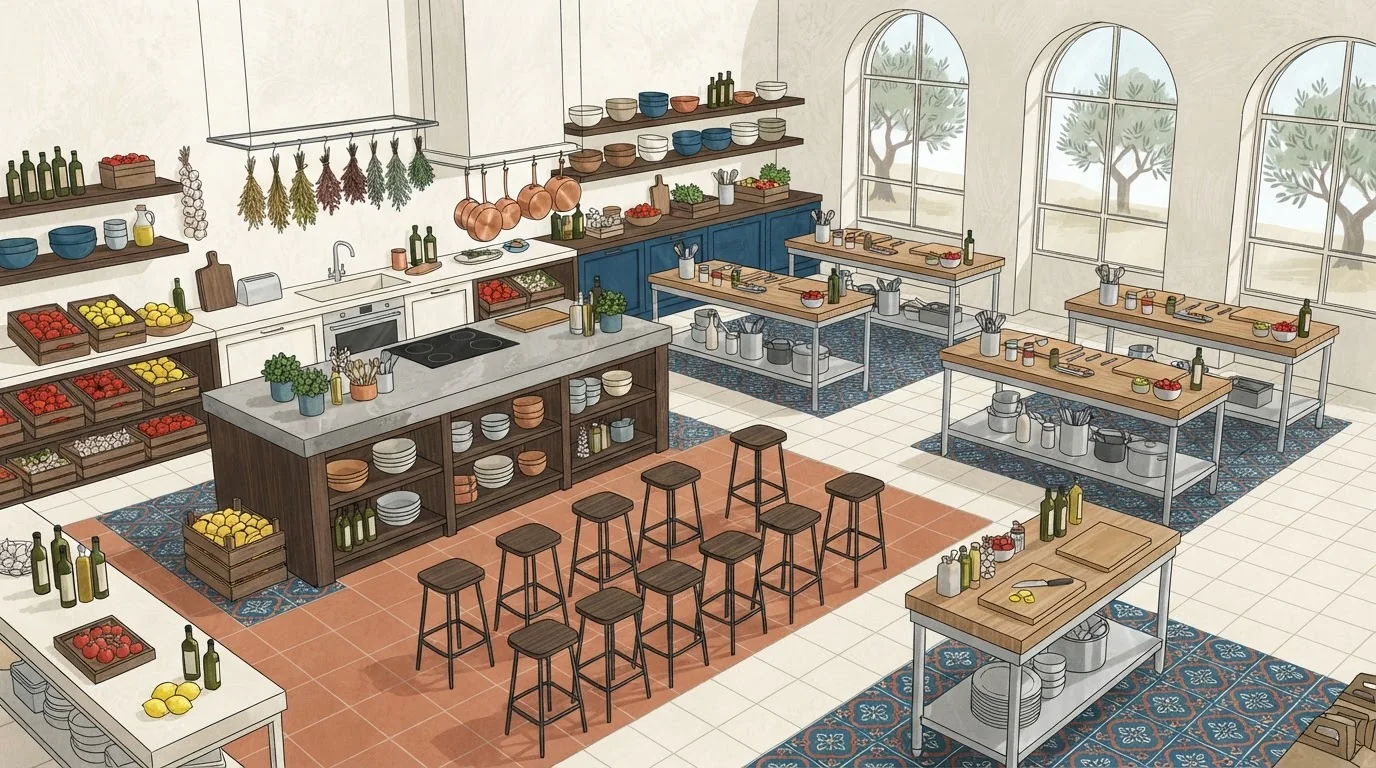
A hands-on session gives each guest a knife, a board, and a task. Ask the instructor how many people can participate at each station for the planned recipe and kitchen layout. For a group of 30, you might need 10 to 15 stations. Example: if the venue has six worktables and each seats four, that is 24 spots. The remaining six guests would rotate in, or the group splits into two sessions.
Ask how many stations the kitchen actually has, not just how many people it can host for a demonstration. A venue that seats 40 for a demo may only have eight hands-on stations. That is not a problem, but it changes the plan. Ask whether the venue can add temporary tables, and whether the instructor can supervise more than a set number of stations at once. Some kitchens cap the ratio for safety and attention. Others are more flexible. Get the cap in writing, because it decides your format more than any menu choice.
Timing matters too. A hands-on session with 30 people often runs longer than a demo because everyone needs to prep, cook, and clean. Ask for a realistic schedule: arrival, briefing, cooking, eating, and departure. Add buffer time for guests who arrive late or want to take photos. If your group has mixed skill levels, ask whether the instructor can pair experienced cooks with beginners. That keeps the pace steady and reduces the number of people waiting for help at the same time.
Demonstration: watching, tasting, and questions
A demonstration format puts one or two cooks at the front. Guests watch, ask questions, and then eat. It works well for larger groups, mixed mobility needs, and shorter timelines. The tradeoff is participation. Some guests love to watch and learn; others feel like they are at a show. If your group includes people who mostly want to socialize, a demo with a long tasting may land better than a full hands-on session.
Hybrid formats exist: a short demo followed by a hands-on component where guests make one simple dish or assemble a plate. That can be a good middle ground. Ask whether the venue can do a split format and how it affects the room setup. A hybrid often needs more staff, because the instructor has to move between demonstrating and checking stations.
Ask about seating during a demo. If guests stand for an hour, some will fade. Ask whether the room has chairs, whether the demo is at counter height, and whether there is a screen or mirror for people at the back. These details decide whether a demo feels comfortable or tiring.
Allergies, diets, and safety
Ask about allergy procedures without offering medical advice. The venue should have a written process for handling allergens, separate boards or pans where needed, and a way to label dishes. You do not need to solve this yourself, but you do need to know what the venue does. Ask who is responsible on the day, and what happens if a guest arrives with an allergy that was not on your list.
For dietary requirements, ask how they handle vegetarian, vegan, gluten-free, or other requests. Do they substitute ingredients, or do they prepare a separate dish? Do they need the list in advance, and how far in advance? Get this in writing. Ask whether the kitchen uses shared fryers, shared boards, or shared utensils, and how they manage cross-contact. You are not asking for a medical opinion, just for the kitchen's written procedure.
The station-and-participation brief
Use this template to compare venues. Fill it in with the venue's answers. Do not assume any number is standard; every kitchen is different.
| Item | What to ask | Venue answer |
|---|---|---|
| Format | Hands-on, demonstration, or hybrid? | |
| Group size | Maximum for hands-on? Maximum for demo? | |
| Stations | How many workstations? How many guests per station? | |
| Rotation | If fewer stations than guests, how do rotations work? | |
| Timing | Total duration for our group size? | |
| Menu | Fixed menu or choices? Can we adjust? | |
| Allergies | Written procedure? Separate equipment? | |
| Diets | Vegetarian, vegan, gluten-free options? Advance notice? | |
| Language | Instructor language? Translator needed? | |
| Space | Indoor, outdoor, or both? Weather backup? | |
| Accessibility | Step-free access? Seating for those who need it? | |
| Cleanup | Who cleans during and after? | |
| Insurance | Does the venue carry liability cover? Do we need our own? | |
| Quote | What is included? What is extra? |
That last row matters. Ask for a written quote that separates venue hire, food, staff, equipment, and any service charge. If tax applies, ask which amount it applies to. The same line-item discipline helps for any group event.
What to send to venues
When you contact venues, send a short brief. Include:
- Preferred date and time window
- Group size, and how many are children
- Format preference: hands-on, demo, or hybrid
- Any mobility or seating needs
- Dietary requirements and allergies, with a clear deadline for changes
- Whether you need a private room or can share the space
- Budget range if you have one, and what it needs to cover
- Whether you want a market visit or ingredient sourcing as part of the session
Ask for availability and a written quote together. That saves a round of emails. If the venue cannot accommodate your group, ask for a referral to another kitchen. Many cooking schools know each other, and a referral can save you a week of searching.
One more thing about menus
Local dishes can be a draw. For example, Visit Greece’s guide to Corfiot food identifies pastitsada and sofrito as Corfiot dishes, but a venue's actual menu needs separate confirmation. Ask what they cook, and whether they can adapt to your group's preferences. Ask whether the menu changes with the season, and whether any dish requires long preparation that would eat into your session time.
The same principle applies: match the format to the people in the room, not the other way around.
The information to send
Before you book anything, send each venue the details above. Then compare the written quotes side by side. The right format for your group is the one that fits your participation goal, your timeline, and the kitchen's actual capacity. No venue can promise a perfect fit without seeing your brief, so send it early and ask direct questions.
Two useful next steps: A wine-tasting event needs a plan for non-drinkers too and Training rooms need space to work, not only to sit.
Planning questions
How do I choose between hands-on and demonstration for a cooking group?
The decision hinges on desired participation and the kitchen's actual station count for hands-on, not just demo capacity. Ask for the station cap in writing, since it determines whether your group rotates, splits, or watches.
What should I ask about allergies and diets without giving medical advice?
Ask for the kitchen's written allergy procedure, separate equipment use, labeling, and who is responsible on the day. For diets, ask about substitutions or separate dishes, advance notice, and cross-contact management. Get answers in writing.